
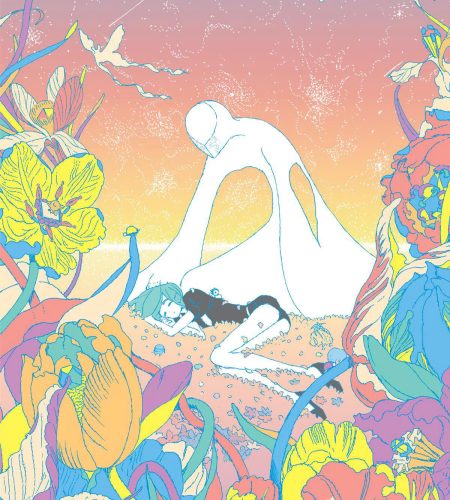
II. Phosphophyllite
1. Phosphophyllite's Starting Point and the Fundamental Limitations of the Gems in Becoming a Miniature Embodiment That Fully Encompasses the Image of Humanity.
Phosphophyllite, in the beginning, was a child who possessed no connection between themselves and the model of reality that Master Kongo had constructed within the kingdom of the Gems, simply because they were far too useless. They had no distinct form of selfhood, separate from the rest of reality, that they could perceive and seek to protect. Rather, their only awareness of an “I” consisted purely in the fact that they were conscious—something that, of course, could not be taken away from a species like the Gems.
And it was precisely because of this that Phos was so kind, so free from self-interest and from the fear of having their self left behind by reality. For Phos was a pure child who reflected the other Gems themselves in their most primordial state, before Kongo carved them into the likeness of humanity—a species that had sullied the gemstones with its own habits. This is evident in the fact that Phos was the only child who still tried to help Sensei purely out of love for him, rather than out of a desire to protect the selfish sense of self that had inadvertently emerged through the originally selfless act of “protecting Sensei”—something that Yellow Diamond and all the other elder Gems had long since forgotten.
Phos's original state bordered on that of being dead, and was also the closest thing to death that the Gems could experience, Padparadscha aside. This was why Phosphophyllite became the potential candidate chosen by the Lunarian prince Aechmea to be transformed from a Gem into a human, and subsequently into a god, since that candidate would also have to become a god sufficiently free from self-interest to agree to grant liberation to both the Gems and the Lunarians. (I'll elaborate on this later.)
And it was also precisely because Phos possessed a perspective unbound to any subjective model of reality that Sensei entrusted them with the responsibility of compiling an encyclopedia for the purpose of classifying everything in nature. For Phos possessed the necessary “honesty” to perceive objective reality as it truly was, rather than imposing upon it a substitute subjective model of reality constructed around their own self-interest.
Returning to that objective reality, from which the descendants of humanity—the Gems and the Lunarians—are attempting to construct a substitute version within their own subjective minds, an alternative model of reality that their perceptual capacities can accommodate and into which their selves can fit snugly. The self initially exists in the form of potentiality, and being granted a role within reality is the condition through which that self can be actualized and contained as an enduring part of reality. In the event that the reality within one's reach does not possess sufficient resources to actualize the self, the role intended to contain that self will only be capable of accommodating a portion of it, while the remainder will continue to exist in the form of will until it is eventually forgotten.
This is precisely what Gems such as Diamond, Yellow Diamond, and Cinnabar resent about the material resources constituting their own bodies, as well as the resources constituting the Gem society surrounding them. Even though they have already come to love and grow attached to the tangible roles they occupy within Gem society, roles they regard as representing their own existence, however incompletely, they nevertheless continue to yearn for change so that they might fully actualize the invisible, formless self existing within them as mere potentiality. Just as Diamond, despite considering the thought that “…being without Bort is painful,” still finds that the other half of the statement, “being with Bort is painful, too,” remains true. And so Diamond continues to pursue either the possibility of going somewhere Bort does not exist, or that of changing the material resources constituting their own body in such a way that they might become stronger than Bort through training. Both courses of action stem from the desire to actualize the portion of the self that still exists only as potentiality.
But, of course, the consciousness of self possessed by an individual Gem is entirely identical to the material substance constituting that Gem, and so none of them would ever consider altering the material composition of their own bodies to be a particularly good idea. Any changes to their bodies substantial enough to bring about a significant transformation in the roles they occupy within reality would naturally also result in a transformation of the very self that those roles were supposed to have been altered to accommodate. If the self itself were lost in the process, then changing one's body in search of a new role would no longer hold any value.
And so, one of the defining characteristics of Gem society is precisely that their bodies cannot grow or develop in accordance with their own desires, nor do they possess any hope of ever achieving such a thing. This deprives the Gems of any motivation enduring enough to drive them to attempt to change the Gem society in which their bodies occupy their respective roles, to reshape that society in accordance with the wishes of their selves. For no matter how desperately they might wish for change, they continue, time and time again, to witness and participate in exactly the same model of society, occupying the same roles, surrounded by the same fellow Gems who have never changed either—even if one of them is taken away and a position within the functioning of Gem society is left vacant, someone else will eventually fill that position, and everything will gradually return to the way it was. The only thing that changes is their yearning for a fragile self that has yet to be actualized within their minds, a yearning that will eventually dissolve into nothingness if left waiting long enough.
There's a particular scene—and this is a little embarrassing to admit, but I genuinely cried when I read it for the second time. It's the scene where Phos and Cairngorm encounter Peridot and Sphene during a reconnaissance patrol, after Phos had already undergone an episode of self-destruction from once again having to bear the responsibility of Ghost Quartz being taken away, following Antarcticite. Phos then hears that both Peridot and Sphene had also once lost their respective partners to the Moon during reconnaissance patrols just like this one, that both had once been tormented by their lingering thoughts of those partners, and that both had gradually forgotten not only that pain but also their partners themselves as time passed.
They went together to ask Master Kongo whether this meant that they were terribly heartless. And Sensei answered that those sorrows and lingering attachments that persist so painfully within their hearts are not things they possess the ability to hold on to, nor are they things they can deliberately make disappear. Sometimes, a miracle suddenly arrives, bringing with it a resolution to those unresolved attachments, and as the lingering attachment to a self that can never be actualized begins to fade, the pain, too, simply slips away all of a sudden. Nobody knows when or how it will happen, but that is simply its nature—it is a miracle. He told them to accept and surrender themselves to the flow of that miracle, allowing their sorrows and lingering attachments to drift away of their own accord.
This information can be connected to Kongo's words about a board game he once spent hours engrossed in, from which we can infer the difference between human beings and inorganic matter such as the Gems. That board game was something created to be played, played again, and then played over and over indefinitely, with no human being ever imagining what an ending in which its role of “being played” had finally been fulfilled would even look like. Even after a game had been completed, the self existing within it in the form of potentiality would still remain, because the board itself would continue to exist, its physical constitution having been designed to allow it to be played for as many more games as anyone wished. The role of being played that humanity had bestowed upon the board game remained lying around on the Moon, until Kongo actualized that role by playing a game, allowing the board to feel relieved for a brief moment. And before the potentiality within the board could once again demand to be played, Kongo liberated it with a prayer.
That is the death desired by both the Lunarians and human beings. But because the Gems—at least according to what the information presented in the story allows characters other than Kongo to know—cannot die in such a manner, they have no choice but to endure the pain that arises whenever they witness a part of their selves being left behind by reality, until they can no longer even remember what that self, with its intentionality directed toward a role from the past, was supposed to be, because their minds have by then become attached to another role that has taken its place in defining who they are—which means that all they can do is wait until a miracle arrives and all their pain drifts away.
In other words, in neither case is any self ever truly granted a complete ending. In the case of the Lunarians, who inhabit a free society abundant in resources that can be molded and reshaped, what they wish to eliminate within themselves is a perspective that perpetually looks toward the future, where even when the current role of a portion of the self HAS ALREADY BEEN FULFILLED, the potentiality within that self still persists, because their awareness of themselves continues to exist. As for the Gems, their society possesses only enough resources to sustain a single mode of operation, with only one role assigned to each individual Gem throughout an existence that stretches on indefinitely, seemingly without any destination. Although this prevents the Gems from falling into the same predicament as the Lunarians, who must continuously evolve, it also means that most of the attachments and suffering experienced by the Gems arise from those portions of their selves attached to roles that have always existed and have been proceeding along their intended course, only to be destroyed by the disruptive variable that is the Lunarians BEFORE THOSE ROLES CAN BE FULFILLED OR PRESERVED WITHIN REALITY, as when their companions are taken away to the Moon, rather than from attachments to roles that have never existed in some imagined future.
This difference does not truly erase the humanity of the Gems, but merely prevents them from becoming creations capable of fully reflecting the entirety of human nature, because there are certain forms of sorrow that arise only after human beings have genuinely made the decision to embrace change, forms of sorrow that the Gems are incapable of experiencing.
When Phosphophyllite first became mature enough to experience the sense of loss brought about by their companions being taken away, and reality began to change, bringing with it a transformation of the very self within Phos, who also began to question the stability of the reality Master Kongo had constructed within the Gem kingdom, we learned that the other Gems had already been suspicious of Sensei for a very long time. Everyone knew, everyone had their suspicions, yet they still chose to go along with this reality despite knowing that it was not absolute. It was not because they believed that everything presented before their eyes constituted the entirety of objective reality, but simply because they placed their faith in the idea that, as long as they continued participating in the form of Gem society constructed by Master Kongo, all their contributions would endure eternally as parts of objective reality. And they would rather accept that, even if whatever remained of their “selves” could never be fully actualized, than gamble on an uncertain future in pursuit of which, owing to the fragile constitution of their bodies, none of them had ever managed to make any progress promising enough to convince them that such a pursuit was even feasible. Just like Cinnabar, a Gem who, no matter how desperately they wanted to escape the kingdom, had never dared to do so because it was something “without precedent,” and because there were “too many uncertainties.”
“Courage” was what Phosphophyllite learned from Antarcticite: that in order to make progress, one must choose to take a gamble and embrace change. But even Antarcticite, for all the courage they possessed, lacked a sufficiently solid foundation upon which to nurture the hope of breaking through the cycle Master Kongo had established within the kingdom—“Even you knew about Sensei's secret, and yet you, even you couldn't…”
Because, as I mentioned earlier, the bodies of the Gems cannot develop freely. Just as no matter how much Diamond might train in an attempt to surpass Bort, such a feat is impossible for a species whose physical structure is as rigidly fixed as that of the Gems. Any changes substantial enough to allow the Gems to become “courageous” to the point where they could independently carve out a new path for themselves, with some reasonable hope of success and without relying on Master Kongo, would necessarily be changes that they could not bring about in their own bodies, because doing so would cause their existing selves to disappear.
And so, regardless of whatever suspicions they might harbor, before they could even think them through thoroughly, their lack of motivation from the very beginning had already compelled them to push themselves back into the role of continuing to maintain the kingdom's operation.
But Phosphophyllite was different.
2. Phosphophyllite's Process of Becoming Human, Rising from a State of Being-in-Death.
Phosphophyllite's body contains highly adaptable inclusions, which Lapis considers capable of preserving the integrity of the self, even if the manner in which that self is expressed—through behavior, ways of perceiving the world, and the tendency to attach itself to particular roles—has changed in accordance with the changes undergone by Phos's body. Phosphophyllite has become incredibly strong, and although strength alone is, of course, not enough, it is precisely because Phos has already established a precedent for becoming stronger that the hope of their being capable of developing even further is entirely well-founded. Unlike an individual who was already strong from the very beginning, such as Bort, Phosphophyllite attained this strength precisely through the courage they used as the motivation to improve their once-useless body.
At first, it was to help Master Kongo, because Phos loved Master Kongo and their fellow Gems. And after Phosphophyllite's “self” truly acquired a distinct identity, separate from the rest of Gem society and the reality surrounding them, through taking on an independent role in the operation of the kingdom for the very first time—the role of replacing their senior, Antarcticite, who had been taken away because of them—instead of living a useless life disconnected from everything in reality, with nothing to grow attached to or regard as a representation of their own self, as they once had, Phosphophyllite began fighting to reclaim the companions who had been taken away because of their own mistakes. They did so in order to resolve their lingering attachment to that guilt and bring about a resolution to the enduring role their self had come to occupy, a role bound to both the responsibility entrusted to them by Antarcticite—“Take my place, and never let Sensei be lonely during the winter”—and the faith Ghost Quartz had placed in them when Ghost was taken away to the Moon while protecting Phosphophyllite, whom Ghost believed to be a replacement for Lapis Lazuli.
Initially, what Phosphophyllite wanted was to bring Antarcticite back because they wished to show him how much they had grown, to report their growth to the senior who had spent the entire winter teaching and guiding a useless child out of his sense of responsibility toward Master Kongo, only for that very child to ultimately become the reason he was taken away to the Moon before he could witness the fulfillment of that responsibility.
But the more Phosphophyllite struggled to change themselves in order to reclaim Antarc, the more the role within reality that had once represented the original self of the formerly selfless Phosphophyllite was left behind, giving way to entirely new roles intended to serve the purpose of bringing Antarc back. Even Phosphophyllite themselves had not realized just how much they had changed, until they came to recognize that the “gentle child” Master Kongo had once spoken of, the pure child unburdened by even the slightest trace of self-interest, who had wanted nothing more than for everyone else to be as happy as they were, before the day Antarc carved a selfish sense of self into their once-pure body, had become little more than a faint fragment of memory, something Phos could only remember intermittently, and sometimes forgot altogether—This is a passage from Phos's internal monologue after they had deliberately allowed Ghost to be captured by the Lunarians in order to uncover Master Kongo's secret: “I don't want to betray them. But the more I try to uncover Sensei's secret (aka a course of action directly opposed to that of the other Gems, who chose to take refuge within the Gem society constructed by Kongo rather than attempt to transcend it), the more secrets I discover within my own heart.”
Master Kongo himself had once spoken of the one precious quality Phosphophyllite possessed when they were still a young, ignorant child: that they were very gentle. That gentleness had never played any role in the functioning of Gem society, but it held value for Sensei—a person who had once always treated Phos, the youngest of the Gems, with particular tenderness—and for Cinnabar, who, even after more than three hundred years, still remained attached to the little Phos who had once taken it upon themselves to find Cinnabar a job simply because they wanted Cinnabar to be happy. (Cinnabar even fashioned a mercury doll in the likeness of the young Phos upon witnessing how much Phos had changed and grown after spending more than two hundred years buried beneath the ground by their fellow Gems.) This value gave rise to a role for Phosphophyllite's former self in sustaining the relationship between Phos and Sensei, as well as the relationship between Phos and Cinnabar. And through the perceptible existence of that role in the form of a relationship, we are given evidence of the existence of Phosphophyllite's pre-winter self, as well as a reflection of how that self gradually faded over time, through the gradual disappearance of the bonds between Phosphophyllite and Sensei, and between Phosphophyllite and Cinnabar, as Phos continued to change.
But if Phosphophyllite could bring Antarcticite back in time, and successfully return this self-interested role to Antarcticite for him to shoulder once again, wouldn't that mean the responsibility currently cursing Phosphophyllite would disappear? If Phosphophyllite could accomplish this in time, before the memory of the innocent child they had once been faded into oblivion, wouldn't they be able to return to their original state, and continue existing with that same weightlessness, free from such burdens, throughout the entirety of their remaining, seemingly endless life?
At this point, Phosphophyllite desperately wanted to rid themselves, as quickly as possible, of this entirely new responsibility and role, which was gradually taking shape like a curse, growing more and more intense each time they became stronger, a responsibility that was forming a new conception of selfhood and increasingly separating the “Phos” of the present from the pure, selfless child they had once been. The Phosphophyllite with an enormous sense of self, who had acquired far too much and therefore had far too much to protect, who regarded far too many external beings as enemies, and who had consequently become far too lonely, as Kongo Sensei had implied—Phos wanted to escape that responsibility and return to the way things had once been by “naively wishing that someone would come back and take care of everything in their place.”
And it was precisely because of this way of thinking that Phos also lost Ghost, causing the process of transition between the old and the new to widen ever further, as they were forced to continually learn to adapt each time someone was taken away because of them. Meanwhile, the self from the past that Phos wished to bring back once again also continued to grow larger, as their responsibility was no longer limited to Antarc, but now extended to Ghost and the other Gems who had come to depend on them as well. Eventually, while attempting to prevent the empty chasm between the new and the old from expanding any further and swallowing what remained of their former self, Phos “repeated that same foolish act of courage” while trying to retrieve Cairngorm's arms, and ended up losing their head.
From this point onward, Phosphophyllite was fitted with Lapis Lazuli's head, and for the first time acquired sufficient intelligence and depth of perspective to perceive a self existing purely in the form of invisible, formless potentiality, beyond anything they had previously been able to witness of themselves through the tangible roles that had existed, and continued to exist, within the Gem kingdom. In place of a mind capable only of “repeating the same old mistakes,” because it knew nothing but how to charge headlong toward its lingering attachment to a bygone past, as though that past were still right there before its eyes, waiting to be grasped simply by reaching out—in other words, taking shortcuts, as Cairngorm described it—Lapis Lazuli's intelligence granted Phos the ability to truly perceive the roles associated with the former self they had lost as a destination lying in the future, and, from there, to chart a long path of intermediate checkpoints leading toward that destination in a way that minimized the need to gamble everything on a single outcome.
Of course, the idea of proceeding slowly in order to avoid the worst possible outcome was not something Phosphophyllite had never attempted to pursue before, since Padparadscha had already advised them to do precisely that from the very beginning. It was simply that Phos's vision of the future had never been sufficiently clear for them to genuinely act, or sustain the motivation to act, on the understanding that those desires awaiting actualization existed as something that could only be reached by gradually completing a series of different supporting actions over an extended period of time. Instead, Phos could only perceive those desires as a source of sorrow that existed directly before their eyes and needed to be alleviated as quickly as possible. This limited perspective not only prevented Phos from truly acting effectively, but also confined their motivation to act to the desire to protect or actualize a self that had already existed within reality through a particular role, rather than allowing them to desire the actualization of a self that had never actually existed within reality at all, but was present only within their mind as a form of “potentiality”—something that, precisely because it had never existed within objective reality in the first place, could not give rise to the lingering attachments and sorrows necessary to motivate Phos to desire its actualization.
Phosphophyllite, much like the other Gems, had, up until this point, been motivated to act courageously only by the desire to alleviate a sorrow that continued to weigh painfully upon their heart amid the transition between the old and the new. And that sorrow arose from lingering attachments to a role from the past that the Lunarians, or some other unexpected transformation, had rendered impossible to continue occupying within the reality of the present.
Possessing Lapis's intelligence allowed Phos to form a clear conception of a self whose role lay in the future, a kind of role toward which an individual's attachment arose not from the fact that it had once existed, but from the fact that efforts had already been made and material resources had already been arranged with the purpose of bringing it into actuality, thereby carving out a vacant place for that role within the functioning of reality before any role had ever actually existed to fill it. And from this, a lingering attachment, a sorrow directed toward a role that had never existed, was born.
=> This is the more advanced state of attachment experienced by the Lunarians, and also what makes the human will such that, even if human beings were to live in a World that never undergoes any change, like that of those immortal inorganic beings, the curse of fearing the void would still never release them.
Phosphophyllite, possessing Lapis's intelligence, was the first to perceive a path sufficiently solid for the resources of their own knowledge to follow in order to reach a role in the future capable of fully accommodating their potential. (Phos mentioned this to Cairngorm as one of the main reasons they wanted to go to the Moon: “I want to know just how far I can go.”) And this was also the first one-sided attachment that Phos had come to feel on their own—that only such a role would be large enough to contain the entirety of their self. Meanwhile, the faith placed in Phos by both the Gems and the Lunarians, their belief that Phos possessed the potential to assume the role of a hero who could seize the future they desired, was the element that genuinely existed within objective reality, transcending the fleeting, one-sided attachments that Phos would eventually forget once they accepted and immersed themselves in reality. It was an element that compelled Phos to continue pursuing this role until they finally fulfilled it, even after they had lost the attachment born from their own solitary envisioning of that path. This is the difference in the degree of attachment between the promise Phos had made to Cinnabar, a promise made unilaterally by Phos alone, and therefore a responsibility they had chosen to shoulder themselves, meaning that if they forgot it, no evidence would remain to remind them of it, and the promise between Phos and Antarcticite—a promise that had transformed the entire winter and Phos's very role within objective reality, something they could not forget even if they wanted to, even after losing their arms, their legs, and eventually even their head, because the change had already been brought into existence and continued to exist independently of their mind.
And then, when Phos finally accepted the encouragement of their companions—“You are our hope, our future”—to the point of sacrificing their current role within the Gem kingdom in order to leave for the Moon, seeking a way to bring about a future different from the model of society in which the Gems were currently playing their roles, a better future that so many other Gems also longed for but knew only how to pray and pray for, that was precisely when everything suddenly began to take a turn for the worse. From Aechmea deliberately exhausting every possible means to the actions of the Gems remaining on Earth that went far beyond anything Phos could have anticipated, all these factors converged to drive Phos into a predicament in which they could neither successfully attain a new role nor return to the role they had once occupied before leaving.
One important factor that must be kept in mind is that Phosphophyllite simultaneously stirred both forms of society that had long since lost the desire to move forward: Lunarian society and Gem society—with the Gems being too afraid to advance, while the Lunarians had already grown exhausted from having to continue advancing throughout eternity. Phos became the driving force that prompted both the Gems and the Lunarians to turn their eyes toward the future and actively contemplate moving forward. Yet for Phos themselves, the exact opposite was happening.
Ever since Phos first witnessed the suffering of the Lunarians, who had been forced to undergo an unending process of evolution simply because of the superior human intelligence remaining within them, Phos had ceased immersing themselves in the future and instead begun contemplating how to bring this relentless compulsion to advance to an end. And the “death” that Phos desired was precisely a return to their former state of carefree innocence, by reclaiming Antarcticite and replacing Lapis Lazuli's intelligent head with their own original one.
Discarding-the-self was a course of action Phos intended to take so that they would no longer feel compelled to pursue some distant potential, only to inadvertently transform their one-sided attachment to that fragile potential into a part of reality itself. And it was a course of action that could only be undertaken after Phos had fulfilled their role as the “hope” of both the Gems and the Lunarians, that is, after they had attained happiness, or the temporary sense of relief that would come from being momentarily freed from their existing attachments. At that point, according to their plan, they would remove Lapis's head and reattach their own former head, the head that could-not-see-too-far-into-the-future, so that they could return to a state of freedom, capable of living for eternity with the happiness that had once seemed everlasting in the eyes of an innocent child like the one they used to be, without ever again having to fear being left behind by reality.
=> Phosphophyllite had come to understand the human desire for death, as well as that of the Lunarians, who were nothing more than the lingering remnants of humanity's thoughts and attachments.
And so, attaining happiness was the prerequisite for Phosphophyllite to be able to die and set themselves free. Aechmea's plan, meanwhile, was to somehow strip away all possibility of realizing Phosphophyllite's vision of their future role, as well as their role within the reality of the present, thereby rendering every role and meaning within reality through which Phosphophyllite had, after all their efforts, attempted to define their own self no longer attainable—in other words, to make Phosphophyllite be left behind by reality completely.
The first crushing blow Aechmea dealt to Phosphophyllite was, of course, his declaration that the Lunarians could bring back neither Antarc nor Phos's original head. This meant that the stage of Phos's plan in which they would remove Lapis's head, reattach their old one, and continue living freely as they once had was no longer a possibility.
If Phos were to simply remove Lapis's head, then rather than seeking a way to continue living beyond suffering, as the child they had once been was capable of doing, they would merely be preventing this temporary feeling of happiness from disappearing by no longer allowing themselves to look toward the future. And this would mean that the only path left for them to escape the future would be to deprive themselves of the ability to experience suffering by shattering their own body, which would also render them incapable of experiencing happiness.
And more than that, if neither Antarc nor Phos's original head could be brought back, then half of the roles that had genuinely existed within reality (rather than merely being uncertain potentialities suspended somewhere in the future) and that Phos had used to define their own self—the role of loving-Sensei, which the child Phosphophyllite had once undertaken of their own accord, and the responsibility of never-letting-Sensei-be-lonely-during-winter, which Antarc had entrusted to them—were also on the verge of being left behind by reality.
Because Phos was determined to fulfill their existing responsibility toward Antarc, as well as the potential awakened by Lapis's brain, they had chosen to abandon their former role within the kingdom as “the incredibly strong youngest Gem whom the other Gems could depend on”—a role Phos could only reclaim if they succeeded in actualizing their potential to become someone capable of “saving both the Gems and the Lunarians,” and then vindicating themselves before their fellow Gems by explaining, “I only did all of this to save everyone.” Losing their responsibility toward Antarc meant that Phosphophyllite also lost the existing role that had been within their reach, leaving them with no choice but to stake everything on distant, potential roles lying somewhere in the future.
The uncertainty brought about by losing a role that genuinely existed, a role that had served as a reserve hollow into which Phos's self could retreat if all their attempts to find a new hollow for a new role ultimately failed, rendered Phosphophyllite's state of mind extremely unstable. So unstable, in fact, that they were willing to lead the Gems into smashing Master Kongo to pieces in order to fulfill their promise to Antarc, even if doing so would subsequently enrage the Lunarians and cause them to grind every last one of the Gems into powder.
Phosphophyllite's most secure existential anchor at this point was Cairngorm, a Gem who, because they carried the lingering thoughts of their predecessor, Ghost, was compelled to protect Phos—the one occupying the role of “Lapis Lazuli,” the figure Ghost had once desperately longed to depend upon—unconditionally, to the point of agreeing to follow Phos to the Moon. Cairngorm/Ghost needed Phos in the role of someone who could guide them forward, a role that genuinely existed, unlike the other Gems who, when they followed Phos to the Moon, regarded Phos's value merely as a potentiality. And so Aechmea separated Cairngorm from Phos, completing the transformation of Phos into an individual whose sense of self had become uncertain because there was no longer any existing role capable of accommodating it. Nothing remained but the expectations placed upon their future.
Phos's existence now depended entirely on variables that had yet to unfold in the future, and so, as Padparadscha observed, they had become so uncertain that they could switch sides at any moment, because there was no longer any existing attachment holding them firmly to either side.
That is why, during the raid on Earth to confront Kongo, which took place immediately after Phos had lost every one of their anchors, and right after Padparadscha had been contaminated with mercury while trying to help them, Phos burst into tears upon hearing Euclase say that the Gems on Earth still needed them. This meant that the role within the kingdom that Phos had abandoned was still there, waiting for Phosphophyllite to occupy it once again. And had Cairngorm not smashed their head to pieces, then, as both Cairngorm and Padparadscha believed, Phos would probably have agreed to return to Earth and abandon their pursuit of a distant potentiality.
Upon returning to the Moon, Phosphophyllite fell into an identity crisis, because even at this point, they had still failed to establish a path toward the future sufficiently solid to convince the other Gems to place their faith in it and genuinely entrust Phos with the role of guiding them all. Following the failure of the operation on Earth, after Padparadscha had been poisoned by mercury and Yellow Diamond had suffered psychological trauma, the Gems on the Moon also began to question the feasibility of the plan. After all, even now, no one truly needed Phos as an individual genuinely capable of helping their species. Instead, they merely regarded Phos as a child serving as an intermediary who offered them hope for a world of everlasting peace, a hope in which they themselves did not even particularly believe.
“You keep thinking that you're leading them toward a better ending for everyone, but the truth is that everyone has only been willing to set aside their own personal desires and help you up until now because they feel sorry for you,” Cairngorm said, implying that none of the Gems, apart from Phos, had agreed to make sacrifices because they themselves recognized those sacrifices as being necessary for the fulfillment of their own ultimate goals.
And although that was, of course, merely Cairngorm's speculation, judging from Yellow Diamond's reaction after agreeing to accompany Phos down to Earth to confront Master Kongo, only to end up psychologically traumatized, it becomes clear that the Gems on the Moon had chosen to throw themselves into Phos's plan, one that “relied far too heavily on estimates,” simply because they had never imagined that things could turn out this badly. Had they truly known the price of pursuing that distant potentiality, they would have given up and accepted letting everything continue operating as it always had, rather than attempting to change things as Phos continued to do. In all of this, Phosphophyllite was the only one bound to that better future so tightly that they were willing to sacrifice absolutely everything just to attain it. Because Phosphophyllite was the only one who had become separated from the rest, lost and uncertain, with no role left to rely upon other than hope.
“The Lunarians see me as a Gem, and the Gems see me as a Lunarian. Then what exactly am I supposed to be?”
“You are Phosphophyllite. You are the hope of us Lunarians.”
“Even when I can't so much as meet Sensei?” Phos shattered their own head after saying this.
Now, the only role Phos had left was that of embodying the hope held within the minds of both the Gems and the Lunarians, a role that existed solely within their minds and would disappear the moment they forgot it. And when Phos decided to risk their life by descending to Earth without requiring any of the other Gems to rush headlong toward their deaths alongside them, they seemed to have begun coming to terms with this role as well, enough to make them want to protect the Gems who had placed their hopes in them (so that they would not “lose everything,” as Cairngorm had said), and to accept being discarded, or dying, as long as the traces of the self they had left upon this model of society continued to survive within the memories of the Gems—which meant that the only existential burden Phos still needed to cast off in order to peacefully choose death was now the role they occupied within the memories of the Gems and the Lunarians. Phosphophyllite most clearly manifested the desire for death that the Lunarians had once experienced when they no longer wished to think about the future. During the final operation to persuade Kongo, Phosphophyllite was broken into numerous fragments by the Gems on Earth and buried beneath the ground for two hundred years. Throughout those two hundred years, technology on the Moon had advanced toward a very distant future.
So distant a future, in fact, that by the time Phosphophyllite was reassembled by Kongo and brought back to the Moon, every hope that everyone had once placed in them had already been forgotten. The worst possible outcome had come to pass: there was no longer a single role, whether one that currently existed or one that might potentially exist in the future, into which Phosphophyllite could fit their self. Even the task of bringing the Gems back, even the task of reconciling the three descendants of humanity to bring about everlasting peace, had already been planned and carried out entirely by the Gems and Lunarians themselves. Phos played no role in any of it, apart from the faint hope that had completely faded away over the course of two hundred years. Upon returning to the Moon and witnessing all of this while still in a shattered state, Phosphophyllite came to perceive the self within them as utterly alone.
All that remained of Phosphophyllite that could still leave an imprint upon reality was their suffering at witnessing everything they had once possessed disappear. And it was this lingering attachment that motivated Phos to continue living rather than discard themselves—because they could not accept death, or being discarded, without first engraving upon objective reality some evidence of all the suffering they had endured, by destroying everything. From here, we enter the genocide arc, where everything that represents Phosphophyllite is reduced to a single emotion: hatred, an emotion that must leave its mark through the destruction of something.
“Only after I have ground every Gem into fragments will I finally be free.” Phosphophyllite's ultimate goal remained the desire to have every lingering attachment satisfied so that they could finally accept death.
“The most human emotion of all is the desire for revenge (…) And thanks to you (Cairngorm), Antarcticite, Ghost, and Padparadscha, Phosphophyllite finally made it to the Moon, came to recognize the fundamental differences and contradictions between the races, and learned a despair so profound that it gave rise to the desire for both death and revenge. With everyone's help, that child has grown into a complete human being.”
At the final stage of despair, when a human being, after all their efforts, can no longer find any enduring existence into which they might entrust their self, Phosphophyllite ultimately chooses to entrust a portion of that self—their feelings of hatred—to the disappearance and destruction of the enduring existences surrounding them, existences that had never had any place for them to begin with.
“If you cannot help me, Kongo, then you might as well just break”—Phos said as they prepared to strike Kongo, implying that he no longer held any value as something capable of accommodating the selfhood of the species that had created him. And then Kongo really did break, because he had been waiting for a very long time for “a human being to tell him that his role had finally been fulfilled.” And because Phosphophyllite had been unable to hear the entirety of Kongo's final words—“Pray for happiness, and then…”—they inserted Kongo's eyeball into their own eye socket, hoping that through his power of prayer, they might finally be relieved of the burdens that had bound them for hundreds of years. What Phos did not know was that they had inadvertently taken upon themselves Kongo's role, and from a human being, they had become an object without a will of its own, created by humanity so that human beings could impose their own selves upon it. And they had also become the one who would shoulder humanity's burdens so that human beings could finally be liberated and pass on in peace.
Here, we learn that Kongo himself is precisely the kind of object Dr. Ayumu had spoken of, “an object that human beings had turned into a decoration for their own lives.” And that the principle underlying Kongo's power to grant liberation through prayer was simply that he occupied the role of an existence within objective reality that would preserve the selves of human beings who had chosen death, ensuring that their selves would never fall into nothingness, because Kongo was the most enduring creation in the World. It was only by entrusting their selves to some other existence, forcing it to live in their place and advance toward the future in their place, that human beings could finally feel at ease passing on, without having to worry about where their lives would go once their consciousness disappeared, or where their selves would go if the model of society they had constructed for themselves were to vanish.
To become an “ornament,” to exist as a representation of someone else's existence and then be forced to live forever, witnessing one's own true self gradually being forgotten as time passes—just as the living must continually carry on the wills of preceding generations, not out of any desire of their own—is a task that no human being would ever want to undertake, least of all the very last human beings remaining in the world. For if they were to shoulder the selves of those who had died before them, then, when there was no one left to shoulder their own selves, where would all the selves they had been carrying within them go? And how long would it take for that entire accumulation of burdens to finally dissolve, so that they themselves could attain liberation? And so they created a tool to undertake that task in their place: Kongo, a creation that would “ensure that the last human beings would not be lonely.”
And as for Kongo, the reason he stopped praying was not simply that technical malfunctions accumulated over his long existence had caused him to lose that ability. He could no longer pray because a machine like him had unexpectedly developed selfish desires and a consciousness of self that belonged to him alone. The Gems revered him as their teacher, he had personally constructed an entire civilized society for them, and he had learned what it meant to be lonely. Enough that Kongo himself no longer wished to accept becoming the one who would have to endure “loneliness” for humanity's sake. And so the damage caused by the meteorite that struck the Earth had not deprived Kongo of his ability to pray. Rather, it had merely amplified his power of prayer, allowing him to grant liberation to the Lunarians, the Admirabilis, and the Gems whom he loved so dearly, all through a single prayer. Kongo himself had acquired a self and lingering attachments, just as he had bestowed selves and lingering attachments upon inorganic lifeforms such as the Gems.
And so, in order to resolve this difficult conundrum, the Gems, the Lunarians, and Kongo needed someone else to take Kongo's place as the individual who would shoulder all the lingering thoughts and attachments of every species still bound to the earthly world.
3. Transcending Humanity.
Phosphophyllite, as we already know, was precisely the individual chosen by the Lunarians. An individual who, throughout the ten thousand years spent receiving the burdens of humanity's preceding generations through Kongo's memories and gradually being transformed into a God, had been deliberately isolated by the Lunarians from the rest of reality, so as to push Phosphophyllite once again into the state of emptiness they had inhabited as a young, ignorant child, allowing them to forget all the lingering attachments they had once possessed, while also preventing a repetition of what had happened to Kongo, where a machine gradually developed a selfish nature through its interactions with the living beings surrounding it. More importantly, Phosphophyllite also had a good starting point: they understood the meaning of liberation through accepting the emptiness of their own existence.
And so, even when Phosphophyllite had not forgotten what the Lunarians had done to them after ten thousand years, they nevertheless chose to liberate all those beings of oil and gas who had continued to bind Phosphophyllite through hatred, precisely because they longed to empty themselves of everything. For if Phosphophyllite could accept severing every attachment, then even if they could no longer experience any existential happiness throughout the almost infinite span of time that remained, they would no longer suffer from loss either. This was the state of emptiness that Phosphophyllite had experienced at the beginning of the story, when, because they possessed nothing, they also had nothing to lose, and because no one expected anything of them, no one had any reason to reproach them either. As a solitary individual bound to nothing, they had once been given a task similar to the one they now possessed: the task of compiling an encyclopedia, likewise intended to preserve and classify every idea that had ever existed in the world under a name. The only difference was that now, Phosphophyllite themselves had become the encyclopedia, preserving everything to which humanity had ever assigned meaning.
“I could turn all of you into eternal slaves. I could plunge you into solar storms and force you to experience the agony of an endless cycle of rebirth. However, today, when I awoke upon this meadow, I remembered what happened long ago. It was here that I stood, alone upon the meadow, when I first received word of that assignment. And here I am, at this very moment, in this very place, alone once again. Which means that, from the very beginning, I have always been alone.
“I will pray, and liberate all of you into nothingness. Whether ten thousand years or a fleeting moment, I have nothing. To reach nothingness—that is your wish, and mine as well. At long last, we have finally come to understand one another.”
And so Phosphophyllite prayed for the disappearance of every living will that had ever been bound to them. And Phos, just like the self they had been in that distant past, once again lay idly upon the grass, waiting for time to pass weightlessly, as though they had never been bound to anything at all. Throughout all those years, Phosphophyllite remained completely alone, not daring to be happy because they were far too afraid of unhappiness, until a new form of life was born and interacted with them for the very first time.
It was an inorganic lifeform, possessing no structure that would allow it to move or perceive anything, and the only thing that granted it the ability to interact with any living being other than itself was its capacity to generate impulses through the Earth's magnetic field. And so, the furthest that its thoughts could ever reach was Phosphophyllite alone. Phos and this lifeform became friends, and together they also befriended other distant inorganic creations, such as a constellation whose biomagnetic activity was the only thing they could hear, or the little stones scattered around them, with whom it would take an extraordinarily long time to complete even a single exchange, a form of communication through which, even after an exchange was completed, they would probably still be unable to fully understand one another. But to them, these were hardly limitations worth concerning themselves with.
“I may not be like you. I may not be able to see the things you can see, but that's perfectly fine. You're very friendly, and you were kind enough to strike up a conversation with me, so I have absolutely nothing to complain about. I'm already completely satisfied.”
These were the words that the first new lifeform spoke to Phosphophyllite. Even though it, too, had spent a considerable amount of time attempting to interact with someone other than itself, so that it might share a portion of its thoughts with another being—an act signifying that this individual also possessed the desire to have someone else hold on to the thoughts that continually disappeared from its mind, thoughts it regarded as representations of its own self—it was, at the very same time, not nearly so afraid of those thoughts disappearing, or of the self attached to those thoughts disappearing along with them. It was capable of being happy without having to fear unhappiness.
At this point, we must return once again to the words of Dr. Ayumu, who said that humanity's greatest weakness lies in its arrogance, in the human belief that one can define a fixed role within objective reality that one's own self can occupy forever, and then regard both that role and that shallow conception of reality as a definition representing one's existence within the entirety of reality. From there, human beings either become bound by the definitions they themselves have imposed upon their own existence, or grow so arrogant that they attempt to force objective reality itself to conform to the constraints of the subjective model of reality they have constructed in their own minds.
And so human beings give names to everything around them, searching for a universal meaning capable of encompassing the entirety of reality, so that they might establish a definition of their own selves that will never fade away. Human beings fear death, fear nothingness, and so this becomes their solution for ensuring that happiness—born from the momentary actualization of their selves through the roles they are granted within reality—will never disappear with the passage of time as reality continues to change.
The Phosphophyllite of the past, particularly after receiving Lapis's head, had sought what they called “the truth,” a state in which every creation, every living individual in the world, would possess a clearly defined identity, and would be capable of fully accepting, needing, and loving Phosphophyllite's self, without having to fear that some unpredictable variable in the future might interfere with or destabilize their conception of how that self was loved, or how it occupied its role within reality, and cause it to change—Phosphophyllite's dream, much like the dream of any human being whose will were to endure forever, was to be loved completely by every creation upon which they depended, so that no portion of their self would ever suddenly lose the love it had received, and no potentiality would ever be left unfulfilled.
“I understand now. I wanted everyone to love me. I searched for so much, and even when I had finally obtained everything, I still never truly understood what it was that I really wanted. Oh, of course that wish could never be fulfilled…”
When Phosphophyllite witnessed, for the very first time, the patience with which those inorganic lifeforms accepted the limitations of their own existence, they, as a god possessing an existence without limits, wept and spoke those words.
Perhaps it is because human beings doubt too much, because they cannot stop “giving something a name so that they can feel more at ease.” These inorganic beings, on the other hand, are not nearly so ambitious, nor are they as doubtful as human beings—a species whose very tendency to doubt prevents them from accepting the happiness born from a finite love, out of fear that their future expectations of the love reality has granted them might be betrayed, thereby giving rise to suffering. These beings, too, feel happy when someone other than themselves acknowledges their existence, just like human beings. But they do not doubt so much that they fear that, should a portion of their self go unrecognized, or should whatever recognition they currently receive disappear in the future, those portions of their self lying beyond their own field of perception would somehow vanish forever into nothingness.
Unlike human beings, or Phosphophyllite themselves in the past, who had isolated themselves and rejected happiness in order to avoid unhappiness, these stones are still capable of feeling happiness without fearing that they will fall into unhappiness once that happiness disappears. The happiness of these little stones still arises from the actualization of their wishes and expectations, yes, but they do not regard any of those wishes or expectations, whether they have already been actualized or not, nor do they regard the feeling of happiness itself, as the “self,” something distinct from the variable elements that are “not the self.” And so they do not fear having that “self” swallowed up by those variables, nor do they fear death.
“A distant light, from so long ago, shines upon every fragment equally.”
A form of happiness that is not born from its opposition to unhappiness, as human beings once understood it, but is simply the opposite of non-happiness. The kind of happiness that arises before human beings have ever considered the possibility of possessing or losing it, like the experience of hearing a beautiful piece of music; the kind of joyful emotion that Pitapat, Kongo's elder brother, regards as important simply because it feels-good, without necessarily having to be connected to some other external existence in order to justify it or preserve it forever within one's reach. It is because human beings tend to perceive happiness, along with everything they regard as belonging to themselves, as something independent of reality that they isolate themselves, and then come to desire death so that they will never again have to find themselves estranged from happiness. To these pure creations, however, every other symbiotic being belonging to objective reality, whether they have ever encountered it or not, is just as precious as they themselves are, because all of them, as Dr. Ayumu said, “are merely parts of the same process of nature.”
This contrast between humanity and the new, pure lifeforms was also what caused Phosphophyllite to begin recognizing the difference between themselves and these beings, and to begin fearing the possibility that they might inadvertently contaminate these inorganic beings with the fear of nothingness that they had never needed in the first place, just as Kongo had once contaminated the Gems with the habits of his former human masters.
“The nature that makes me wish I could dissolve into nothingness even when I am perfectly happy is a manifestation of the humanity within me, the part that is trying to cling to existence and continually striving to evolve.”
And so, throughout the final tens of thousands of years of Earth's existence, as Phosphophyllite and the new lifeforms spent the remainder of their long lives idly indulging in the most primordial feelings of contentment imaginable, Phos still wished that they could somehow erase themselves, along with whatever remnants of human nature might still be lingering within them.
“Hey, no matter how much you worry, the inevitable end will come for all of us eventually. Even this planet will one day break apart into countless fragments and become the material from which new planets are born. Even those individuals who have flown far, far away from this universe will eventually come together and merge into one another, healing the wounds born from evolving too hastily as they become the material from which a new universe is built.”
“Everything will change eventually. Only the present matters. All those worries and regrets and whatever else, they're all nonsense.”
Pitapat tried to reassure Phosphophyllite, enough that the group of friends could continue lying around and relaxing together for another several tens of thousands of years; until the Sun had swollen to an enormous size and was preparing to swallow the Earth as fuel for its own burning, when they finally woke up and began preparing to evacuate aboard the ship the Lunarians had left behind before attaining their complete liberation. And at that moment, there was one particular aspect of Phos's thinking that drew a very clear line between Phosphophyllite, “a human being who had learned to cast off human nature through spiritual cultivation,” and the other pure lifeforms, who “had never been human” to begin with.
Phosphophyllite, still reasoning according to their past experiences, believed that leading the others away to escape was merely “a temporary solution for evading the inevitable end of this universe,” and that thought alone was enough to discourage Phosphophyllite, because they no longer wished to have anything to do with that human tendency to flee from nothingness.
But in reality, the reason these stones wanted to leave was simply that they “had just come up with a new song and wanted a little more time to enjoy it together.” There was not the slightest trace of humanity in any of them, except for the remnants of humanity that still existed within Phosphophyllite, which had only been transcended for a moment because they had been suppressed by Phos's own growth. The biological traces of humanity still remained, and the possibility that they might once again overpower Phosphophyllite's will was entirely real. As someone who had successfully built a bridge from human society to the new, pure world of inorganic beings through spiritual cultivation, Phosphophyllite was the final bridge between humanity and these stones.
And so Phos, together with the humanity remaining within them, accepted being consumed by the Sun, so that the new lifeforms could continue living in a pure World without fear of being contaminated, far, far away from this star system. “Burn the bridge, will you?” And during the ship's departure, Pitapat broke off a fragment of Phosphophyllite from within the god who had once been Phos, and promised that whether or not that fragment still contained humanity, they would prevent human beings from invading the pure World to which they would bring this little Phosphophyllite. Pitapat promised Phos that they would take care of this child within them, “the youngest sibling” among the minerals, and allow the child to grow up to be as gentle as Phosphophyllite had originally been. Meanwhile, the composite being of the god who had once been Phosphophyllite was consumed by the flames, along with the remnants of human nature still lingering within them.
“Human, you really are such a coward. But don't worry, I'll stay by your side until the very last moment.”
“It's finally over… I feel… light. So, so light…”
Subscribe to our email newsletter to get the latest posts delivered right to your email.