
[This review evaluates the movie independently of the overarching storyline of the entire Backrooms universe, as the writer personally doesn’t know a single thing about Backrooms lore.]
This interpretation of BACKROOMS is based entirely on my memory and the linear map of the plot that I drew up in my head while watching it for the first time in the theater, so there may be a few inaccuracies concerning the details of the story. BACKROOMS is a bit nonlinear, so doing this means that the map of the plot I’m recounting and publicly posting here may very well deviate from what the movie actually presented to me in the past, so please keep that in mind before reading.
This is also kind of like what would happen if someone were to describe every last detail of a dog to a kid who had never known what the fuck a dog even was, then ask that kid to draw one: what they ended up drawing would certainly look somewhat like a dog at first glance, but upon closer examination, it wouldn’t really resemble a dog all that much. Because, fundamentally, the details and visual information that the image of a dog leaves behind in human memory aren’t really a sketch of the dog’s actual form transmitted directly into human consciousness—the dog isn’t stored in human memory as something resembling a complete image, but rather, the concept of a “dog” is stored as a few small details sufficient for humans, when those details are received together by the retina, to recognize that the bunch of visual signals their retina is receiving is depicting a concept called “dog.” As in, humans remember things through the conceptual associations evoked by the habitual activation of certain familiar details.
Because once these details have been linked together and given a name in the form of a concept, whenever one of those details is brought to mind, the rest will also habitually pop up along with it—kind of like that whole “neurons that fire together wire together” thing (I’m not making this up). That’s why, when describing a dog to someone else, if they’ve never seen a dog before and don’t already have a concept of “dog” in their head, they cannot rely on the scattered little details they’ve been given to fill in the blanks on their own and draw an actual dog, based on the associations evoked by the concept named “dog.” And that’s also why memories themselves are rather vague, and why every time we recall something, a few details will be forgotten if they haven’t been attached to the concept as tightly as the other details that serve as cues.
So this whole “describing a dog to someone who’s never seen a dog before and asking them to draw it” thing doesn’t just apply to me and this very piece of writing, but also to the relationship between humans and the Backrooms, between the Backrooms and humans, and even between humans and themselves.
The idea concerning the way memories change, or become “not quite like the thing we’re trying to describe anymore,” every time they are brought back up by the brain in an attempt to recall an event from the past was first implied by a statement in a book “encouraging people to courageously step outside their comfort zones” by the psychiatrist Mary, when she referred to the brain as “an ever-changing structure,” placing it in parallel with the ceaseless transformation of the reality in which it exists. Because the brain observes the World, the reason why the details it retains are so limited, and why the conceptual associations between individual details are so easily shaken, is that it needs to change/sacrifice some of its existing associations in order to form a new association, and at the same time, create a new concept for the changes that the World allows it to witness.
These new associations that break away from the old ones aren’t necessarily worse than the old associations. They only become worse when people “fail to understand the as-yet-undefined World” that they have taken into their minds well enough to find, on their own, a new association/definition with which to define it in accordance with their own will, rather than some other arbitrary associations that they never wanted to keep in their heads in the first place. Or those new associations are worse because, within that world extending beyond the associations that people have already known, accepted, and loved, there already exist associations/concepts established beforehand by other people who possess the authority to define them, and those associations go against their own will. And because they don’t want to take all those new associations that go against their will into themselves, only to have to sacrifice the old associations they hold dear in return, what remains of these people after every journey in search of new associations for themselves is precisely who they were before they left, who they were back in their comfort zones, right before they embarked on their journey to search for better new associations, without having made any progress at all.
That’s why the movie presents two contrasting cases: one is the architect (the person who has the authority to determine associations), and the other is the salesperson selling furniture designed by architects (the people who live under associations, concepts, and meanings determined by others). At the beginning of the movie, the protagonist, Clark, wants to become an architect, but he can’t, and instead has to work as a furniture salesman despite having a degree in architecture. Furniture made by other people and chosen for purchase by other people.
Basically, Clark’s situation goes something like this: He wants to step-outside-his-comfort-zone/ break away from the habits he’s been following in order to fulfill his dream of becoming an architect—to become someone who has the authority to determine the associations that already exist in the world outside, so that he can come to possess new associations that transcend the bunch of old associations that have been worn down and gradually forgotten even by himself inside the house where he takes refuge. Because even though his brain still wants to remain sheltered within his comfort zone, it has already developed beyond the protection that his safe family environment can offer, through its observation of the changes taking place in the outside world, so that refuge can no longer provide him with any comfort. Clark needs new associations, in new places. Even if he wanted to remain rooted in his comfort zone, he couldn’t, because it’s his brain itself that has already developed beyond the boundaries of that comfort zone, precisely because it has become aware of things belonging to the rest of the World (both physical and nonphysical) that exist outside of it.
But every place in the world has already had someone else’s hands all over its associations. And so, when he discovers a vast, irrational place that seemingly belongs to him alone, like the Backrooms, he becomes absolutely determined not to call the authorities and have actual scientists with actual protective equipment come help him investigate it. Instead, he chooses to map out the Backrooms himself and try to understand it on his own, because otherwise, the Backrooms would be taken away from his ownership.
The Backrooms is an entity (to use the term employed by the movie’s translation) of infinite size, capable of recognizing the individual details that the human brain has firmly retained in its memory from a particular moment, then attempting to imitate them in order to create a replica whose outward appearance resembles those moments as closely as possible, based on its own interpretations of the clues provided by the details stored in human memory. Each of its levels represents a transformation of the memories belonging to the brain that it is trying to imitate, so every association or desire existing within the fragments of memory that the brain wishes to hold on to will be continuously brought into reality by the Backrooms for all eternity. Clark and Mary describe the Backrooms as a human “brain” itself. And when Clark’s brain exists inside the Backrooms, aka exists within itself, that’s basically a cheat code that allows him to avoid having to endure the feeling of alienation that comes from the rest of the World not belonging to him/ not conforming to the associations that he himself believes define who he is.
And, um, it’s a place that tenderly embraces people like Clark and Mary’s mother, an eternal refuge where there is no longer any “outside World” for them to gaze out at helplessly. The familiarity of the Backrooms is a facade concealing the fact that it doesn’t even fulfill the very first condition required for a good association to come into being: the brain that possesses the association must understand the place with which it is about to form that association, so that it can determine for itself what kind of association will emerge afterward, one that fits its own desires. Because nobody understands how the damn thing works at all. It uses this veil to lure people in, and what it intends to do with them is anyone’s guess, but whatever it is, it goes against their wishes from the very beginning, and the Backrooms wants to keep that purpose hidden.
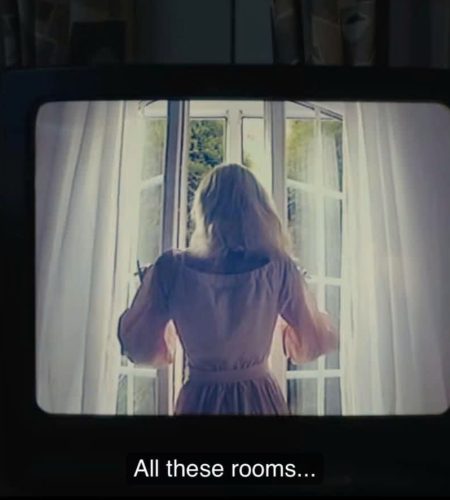
After Mary’s mother was deceived by the Backrooms and managed to escape from it (or experienced some similar trauma in the outside world), she began suffering from psychological trauma and became terrified of leaving her comfort zone. Because out there, she would either be caught off guard by something whose appearance and mechanisms she knew nothing about, or be driven into a situation where she had no choice but to seek refuge in a place like the Backrooms. She barricaded her doors and sealed up her windows so that she herself would no longer be able to witness the World outside, so that her brain would stop moving forward. That’s why Mary uses the phrase “opening the windows to step outside one’s comfort zone, and finding a way to take control of one’s own life out there” in her books, because she wants to save people like her mother, and like Clark (she fails).
The complete novelty of the Backrooms, which has yet to be filled with any meanings, concepts, or associations, is also why so many people want to understand it, so that they can establish associations upon it according to their own will, just as Clark attempted to do by drawing a map of the Backrooms. That’s why there are those scientists at the end of the movie, and why, even at the beginning, there is evidence suggesting that they have installed numerous audio and video recording devices inside the Backrooms and regularly sent people in to monitor it. Personally, I also think that the recording of greetings in every language in the world is itself an attempt by human scientists to actively communicate with the entities inside the Backrooms.
In this regard, human scientists are actually very similar to the entities within the Backrooms, because both sides want to understand each other, in a certain sense.
Subscribe to our email newsletter to get the latest posts delivered right to your email.