
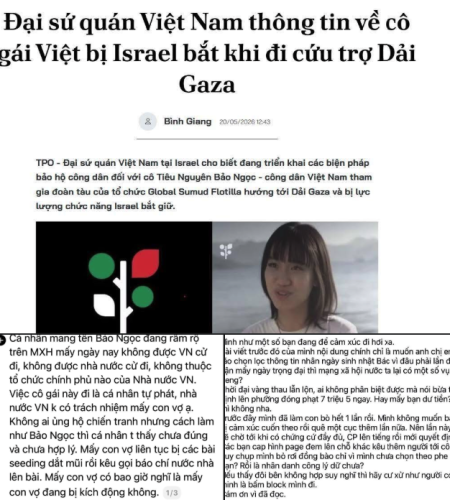
Context: In May, while the Barbaros cargo ship, carrying a Vietnamese sailor named Tieu Nguyen Bao Ngoc, was traveling through international waters to deliver humanitarian food aid to the Gaza Strip, the Israeli forces illegally intercepted the vessel and captured those on board. In response, many young Vietnamese people urged the Vietnamese government to break its silence, condemn Israel’s actions, and, most importantly, demand the release of Tieu Nguyen Bao Ngoc. Others, however, criticized these efforts, claiming that the posts urging the government to take action were spreading misinformation manipulated by the West, as no official news from the government had publicly announced the event yet. They went so far as to demand that such posts be taken down and that their authors be imprisoned.
——–
After the incident involving Ms. Tiêu Nguyễn Bảo Ngọc, I personally drew two conclusions (besides the fact that so many Vietnamese people have such a terrible sense of standing up for their rights): First, the more selfish I am, the more I should care about the war in the Middle East; second, the act of ordinary people discussing and raising suspicions among themselves is something that should be normalized and should not carry consequences, even when those suspicions might turn out to be false— people do not need perfect evidence to have the motivation to raise questions. Because what suspicion needs is motivation, not evidence for an accusation.
———-
1. Personally, I don’t like the idea of treating the choice to provide aid to Palestinians as something that only people who are capable of deep empathy and know how to think about the interests of others/put others’ interests above their own would make. Because those are qualities that not everyone actually wants to strive for, especially within the modern economic and social model. And also because I believe that as long as you do not fall within the scope of protection provided by the US and Israel, then regardless of whether you are red, green, right, or left, you should want to stop these two.
The decision to provide aid to the Palestinian people, or to any other territory, as I see it, is a rational and highly utilitarian decision, rather than merely a decision made by people who are overly sensitive, overly empathetic. Because the growing strength of a more powerful empire will create an imbalance of power between that empire and the remaining smaller countries, which in turn means helping the empire claim the right to violate international law (something that the entire world has collectively agreed to abide by thanks to the balance of power) in order to interfere with the resources and interests of countries that, no matter how far away they are from the empire, are still too small to resist it on their own, like us.
Therefore, we need to cooperate with other small countries to reinforce one another’s strength, as well as to protect our allies from being swallowed up by larger countries. We do not need the ability to “empathize and sympathize with outsiders” to feel threatened by Israel and the US; we only need to sympathize with ourselves and think about our own interests, and that alone is already enough to make us want to stand up against imperial powers, no matter how far away they may be from us.
I’m not saying that if imperial powers grow stronger, they will inevitably swallow up smaller countries like us. But if we keep letting things continue at this rate, then we are giving them the right to choose to do so if they feel like it.
2. People should not bind themselves to official sources of information from the state to the point of seeking to impose consequences on those who want to raise suspicions, simply on the grounds that doing so is “dividing” national unity. And as for those of you who want to raise suspicions, just go ahead and raise them.
The argument that even “suspicions supported by evidence, raised to question and put pressure on the state, would ‘divide the collective from a great common ideal—represented by the state'” only holds true if the “common ideal” being referred to in that argument is an immutable ideal, one in which simply following whatever the ideal tells us to do is what constitutes being right. But if what the act of raising-suspicions is supposedly “dividing” is merely a moment of doubt, a dispersion of the people’s trust in the government, then aren’t the people making this argument equating the image of the government itself with that very formless, intangible ideal?
Remember that, after all, the physical embodiment of the government was something that we collectively constructed in the first place, modeled after the ideal that the collective body of citizens chose to follow, and the government is merely an intermediary step that brings people together to realize that ideal through the strength of the community. Here, it is the government that must seek to “imitate” the qualities required by the ideal, rather than the ideal having to chase after the unpredictable and easily changeable nature of the government—the government is composed of individual human beings, and human beings are unpredictable and easily changeable. Therefore, the current embodiment of the government in our country, as well as those of all countries everywhere in the world, does not necessarily have to fully reflect the ideal, much less serve as a model that we must obediently follow to the letter simply because we believe that the ideal we ourselves wish to follow resides within the government itself.
That is why the Vietnamese state supports the people’s right to freedom of speech, as well as the idea that the people should be informed of every decision made by the government, monitor those decisions, and contribute to what the government proposes (“The people know, the people discuss, the people do, the people inspect”). Because the people’s right to demand that their suspicions concerning the government be addressed and verified is not, in itself, an accusation, but rather a suspicion seeking to be brought to light, because the information they have so far received directly from the state through official, verified channels differs drastically from the information they have independently gathered on their own.
The images and evidence they are presenting to “prove” their suspicions—such as the passport photo and the video featuring Bảo Ngọc—although they serve the role of evidence, are actually merely the motivation for many individuals to believe in the same suspicion, come together as a collective, and jointly demand CONFIRMATION OF WHETHER THE INFORMATION IS ACCURATE OR NOT. These pieces of “evidence” themselves cannot/do not yet qualify as evidence intended to make an accusation, so it would make no sense for those who circulated the passport images and videos above to face legal consequences for what they did if those images and videos turned out to be false—At present, they are not false, but EVEN IF THEY WERE FALSE, those people still should not have to face consequences.
Because the truth is that requiring non-specialist individuals to find decisive, no-longer-disputable evidence entirely on their own before sharing information and their own suspicions with others, or before raising a suspicion about someone/some power, is an unreasonable demand. Because if that were not the case, what would we even need detectives and lawyers for? They need money to conduct in-depth investigations. Where is that money supposed to come from? From those individuals alone, investing all their money into a single suspicion? It’s not that there cannot be people willing to pay for it, but there will be very, very many people who cannot. And with that alone, how many unresolved issues would we inadvertently overlook simply because of that supposed “lack of evidence”?
Subscribe to our email newsletter to get the latest posts delivered right to your email.
The reason why we help the strangers that are far from us is that we resonate with them emotionally and we have spent enough time immerging ourselves in their symbolic world. As in the case of Palestinians, many people like Bảo Ngọc risk their life to support them because they have spent time watching Palestinians' hometown be destroyed, because they are Muslims or because they have left-wing consciousness (I think you've already known that the left consciousness in general has painted Islam as a peaceful religion being oppressed by Western Christianity). Many people outside those cases will often find it hard to have sympathy with the Palestinians. Not because they are cruel, because they still don't invest themselves emotionally on the story of Palestinians. As for me, I'm a Christian. I was inherited from the Jews their Hebrew Bible. They were the people my Lord came from. And as a Christian, I feel guilty of centuries of anti-semitism that was caused by Christians. So of course, my compassion often leans towards the Jews especially when looking at their survival instincts and their desperateness to hold on to the ancient symbolic land that once belonged to them. But now I see that they've gone too far. That's the tragedy of war and I think you already know when reading Vinland Saga. We may kill the first person because we have the righteous reason to do, but when we kill the 10000th person, it is an irrational murder. Sin weakens your conscience and drives you to animality.
View on Facebook
Johannes De Silentio Still, nói như vậy vẫn đang exclude những cá nhân không có khả năng đồng cảm với người Palestine khỏi việc muốn giúp họ rồi. T lại nghĩ giữa các cá nhân khác nhau và giữa các quốc gia khác nhau liên kết với nhau chặt chẽ hơn việc chỉ dựa vào sự thấu cảm. Nếu không chúng ta đã không hoà bình được lâu đến như vậy
View on Facebook
Hạ Linh Việc muốn liên kết chính trị với các quốc gia không đơn giản vậy đâu á bạn. Phải tùy thuộc vào hình ảnh quốc gia đó nữa. Ví dụ như Palestine đi, nhiều người vẫn có định kiến rằng Palestine là Hồi Giáo và Hồi Giáo bị trưng ra một bộ mặt rất xấu bởi truyền thông phương Tây. Hơn nữa Israel là đối tác chiến lược của Việt Nam nên việc mà muốn người ta ủng hộ một đất nước mà mình có ấn tượng xấu để chống lại một đất nước mà mình đang có mối quan hệ hợp tác là điều mà mình nghĩ là rất khó.
View on Facebook
Johannes De Silentio Đúng là vậy.. Nhưng nhưng không phải những gì Israel và Mỹ đang làm đã phá vỡ tất cả những gì mà phần còn lại của thế giới đã thống nhất với họ trước khi lập mối quan hệ hợp tác hay sao? Nếu vậy thì cái Israel và Mỹ đó đâu còn như trước kia nữa?
View on Facebook
Hạ Linh Mình mô tả để bạn biết rằng đó là rào cản nhận thức của nhiều người bây giờ ngăn cản việc họ ủng hộ Palestine. Và việc cần làm là phải phá vỡ rào cản nhận thức đó đã. Mình không hề biện minh gì cho Israel và Mỹ. Mình chỉ đang phân tích cơ chế. Mình không phải là không có lý do gì để phản đối Israel. Đồng cảm với đau khổ của dân Palestine là một chuyện, mình cũng rất bất bình vì nhiều nhóm Ki-tô hữu thiểu số ở Gaza cũng bị áp bức.
View on Facebook