
———
P/s: Except for the parts that say “Buddhism says so” and the quotations from Houseki no Kuni, everything else is something I reasoned out on my own just to have an excuse to show off my Lapis Lazuli keychain, so I encourage you to judge it based on its logical coherence, as in whether your own brain finds it reasonable, rather than treating it as a piece of writing meant to provide knowledge.
———
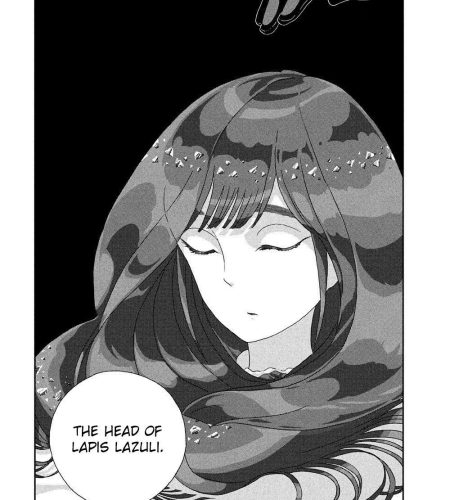
While casually scrolling through the Houseki no Kuni fan community’s Wikipedia to look for reference material, I only happened to discover that the glittering golden halo/laurel wreath surrounding Lapis Lazuli’s head, which in many fan artworks is often reimagined as a luminous ring around the head resembling the halos commonly seen in popular depictions of angels, like in the picture, is actually a type of iron ore with a metallic golden sheen that looks quite similar to gold, which is why people often call it “fool’s gold.”
And that is pretty funny, because the very path and ideal destination that the character Lapis Lazuli is constructed to aspire toward throughout the entire story—the very thing that gives Phos hope of resolving the conflicts between person and person, between gem and gem, as well as between humans/Lunarians and gems, aka putting an end to the endless war between the Gems and the Lunarians—is also precisely the path and ideal destination that many scientists believe in and strive toward, not merely as a dream meant to satisfy a simple aspiration, but also as a “point of equilibrium” that would bring an end to the contradictions between separate individuals whom nature has determined must eliminate one another in order to survive: “Absolute Knowledge.” And the funny part lies in the fact that this very path, along with the belief that one day in the distant future humanity might be able to complete it, might be able to attain “absolute knowledge” of every possible move that reality could ever make, is precisely the path that receives some of the most judgmental side-eyes from Buddhists, because it reflects humanity’s inherent arrogance in assuming that it could somehow discover the absolute principles governing the operation of reality and hold them permanently in the palm of its hand—that is, to transform reality from something “impermanent” into something permanent, the very disposition that Buddhism calls “ignorance” (avidyā, meaning stupidity).
An unshakable belief that plays a central role in constructing the ideological foundation of Buddhism is that all things are impermanent/ constantly changing, and for that very reason, as long as human beings remain ignorant/ remain arrogant and believe that they can establish an absolute universal law governing all things, so that they may observe reality as a static whole encompassing the entirety of space-time existing within it, human beings will continue to suffer, because as long as that remains the case, they will still be unable to accept that the things which have been lost as reality transforms itself have disappeared into meaninglessness.
That attachment/ primordial longing to hold on to reality so that the reality one currently holds in one's grasp will not be swept away into the past is precisely what Buddhism considers the root of all suffering. One only needs to look at Kongo and the eternal society of Gems that he wishes to keep by his side forever to see this, as he blinds them with lies about objective reality and only allows their vision of “what constitutes reality” to be confined to that one tiny kingdom alone, operating through the same monotonous cycle over and over again for all eternity.
The problem with constructing a simplified model of reality and then imposing that model upon objective reality lies in the fact that it is… not the truth. That artificial “reality” does not encompass the entirety of every possibility that could ever unfold within objective reality, but instead depicts and worships only one single path and one single shared destination, while all other paths and destinations are cast aside to prevent them from developing to such an extent that they might replace the current path to which Kongo is attached. Therefore, if there exists any Gem that conceives of paths other than this one, then they certainly cannot find fulfillment within the operating system of the Gem Kingdom—Diamond (the Gem who cannot accept the limitations of their own role within the kingdom), Yellow Diamond and Phosphophyllite (the Gems who can no longer continue fighting for the kingdom's shared path and objective while still being haunted by the comrades who were taken to the Moon), along with all the Gems who chose to go to the Moon in search of another path, are precisely such individuals. And it is also precisely because the two factions of Gems hold DIFFERENT conceptions of a shell of “simplified reality,” with only one single path, one governing principle, and one shared meaning through which they can “make permanent” an impermanent reality within their minds, that the conflicts between the Gems and the Lunarians, as well as the conflicts between the Moon Gems and the Earth Gems, come to exist.
So, is it that conflicts arise because each side merely cuts out a tiny slice from the infinite possibilities of reality and uses it to constitute its own selfhood, such that these randomly selected slices end up opposing one another and thereby giving rise to conflict? Then why don't we cut out a really, really large slice that encompasses every possible path, every possible rung of meaning/ short-term destination, and then witness with our own eyes the absolute, eternally enduring meaning that this entire objective reality will ultimately arrive at after traversing countless such paths and short-term meanings/ destinations, so that from there we can form a selfhood of our own with an objective/ meaning that can never be overthrown, precisely because it is already the absolute objective/ meaning? That is to say, if we could all recognize that we ourselves are operating within the very same genuine objective reality, then wouldn't it follow that no one would ever be left behind, because even though we may set out along different paths, ultimately all those paths are operating within the same system, all heading toward the same destination?
At least, that was the idea Lapis Lazuli passed down to Phosphophyllite, one that Phos himself brought up after becoming God and praying for everyone to return to nothingness. Phosphophyllite would later call it humanity's inherent “insatiable greed,” and resolutely protect the world's new, pure beings of matter from following in humanity's footsteps. So, where exactly does the problem with this solution of “absolute knowledge” lie?
It's very simple, human beings are not creatures who are already empty from the moment they are born, and the act of searching for a self is not merely a desire that comes afterward either, so ordinary human beings cannot simply accept identifying themselves with some arbitrary conception of selfhood called “themselves” just because they happen to recognize it; rather, they must actually compare whether that selfhood/ role within the model of objective reality is compatible with their own invisible “free will” that still needs to be actualized. That is to say, free will itself exists before human beings become conscious of their own selfhood, and selfhood must be something forced to conform to free will (based on what people say about demand coming before supply🐧🐧🐧). Therefore, even if we were to discover a mathematical formula capable of describing the entire flow of the universe, and human beings could see in complete detail the role that their own free will would play within this reality all the way to the very end of time, would the “free will” existing in the present reality, looking at the actions that it has already been predetermined to choose to perform in the future… still be able to choose otherwise, when at that very moment it has not-chosen-anything-yet? If not, then wouldn't that mean that this “free will” would ultimately still be left behind, never again having the opportunity to be actualized, and for that very reason, the framework/ shackles that bind it and deny it the right to freely act according to its own will would now become “itself”—human beings, at this point, instead of fighting against the shackles imposed by the ideals of some dictatorial old politician or the constraints imposed by society in order to attain freedom, would have to fight against themselves; But if it could choose otherwise, then wouldn't that mean that the “absolute knowledge” which promises to provide an understanding of selfhood whose value would endure for all eternity is actually neither quite so “absolute” nor quite so “eternal” after all?
So this act of cheating, with the aim of putting an end to both conflict and suffering, by choosing to pursue absolute knowledge rather than accepting the need to abandon one's own tendency to cling to things, is considered pretty average ignorant folks' behavior.
Subscribe to our email newsletter to get the latest posts delivered right to your email.
B-bai nay bi nhieu bo share ve wall chửi hay sao ma số react nhiều bằng số share hay vậy 😭
#johneewalkee
View on Facebook