
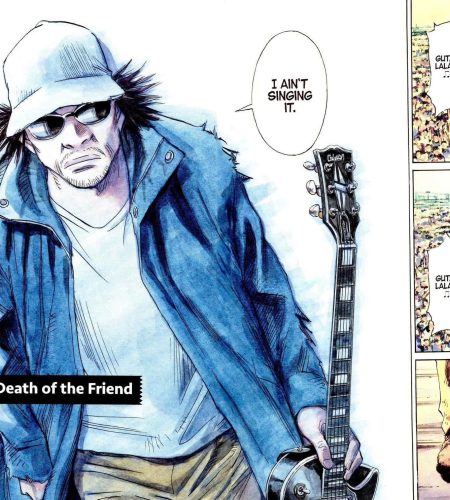
Right at the climax of the final battle between the protagonists and the remaining remnants of evil from the Age of Friendship, 21st Century Boys inserts a scene in which the mangaka discuss among themselves how they are going to record this heroic story:
“The hero defeated the villain and successfully protected the Earth. And then, what comes next? If it simply ends like that, it would be rather boring, wouldn’t it? There is a problem with heroes in that they can only be heroes within the lines of a narrative structure in which everything they fight for ultimately succeeds, and that ultimate success marks the end of the narrative sequence in which they are heroes. If the hero remains alive afterward, he will simply grow old.
That is why stories usually end with the hero walking off toward the sunset and disappearing, or simply dying. Quite sad, isn’t it?”
And that is also how the heroic role-playing games of children like Kenji unfold, in that they would only proceed up to a certain point where every aspiration of the person proclaimed to be the hero has been completely fulfilled. Beyond this threshold, everything in reality that lies outside the lines of the narrative in which he was once a hero will continue moving forward, leaving that already concluded story behind as merely a small stage within another, much larger story, whose ultimate ending remains far more distant. That is the very nature of the game those children used to play when they were young, where a story had been unilaterally agreed upon among themselves, in their capacity as the gods who determined the contents of their own minds, and where, accordingly, they also cast themselves in the roles of the heroes who would bring the entire story toward the ending it needed in order for every event, every individual little play constituting that larger story, to fulfill its purpose within the narrative.
The world of the protagonists like Kenji, back when they were still children, likewise revolved around a great many such short-lived stories meant to satisfy the scope of what their consciousness was capable of imagining. When they were young, they could spend entire days immersed in stories they had mutually agreed upon, with meanings they themselves imposed upon everything around them for the purpose of moving toward the proper ending of the story contained entirely within their own minds. Those were the lines of narrative written in the Book of Prophecy they had drawn, imitating the narrative structures of the manga they read, with a kind of discourse through which only they themselves could understand what roles they occupied within the story they had constructed, and what every individual playing a role in that story needed to do in order for the appropriate ending to arrive. And because it was a story composed of numerous situations randomly stacked upon one another, following whatever ideas their brains happened to come up with at any given moment until those ideas gradually became a long story moving toward a destination that only they themselves, at that time, could understand, when their childhood game had come to an end and Kenji and the others eventually grew into adults, began working as employees under the authority of the big figures of the commercial world, and could no longer afford to spend entire days on those inconsequential little plays in which they themselves were the central characters, they had forgotten everything that the little child who had once been their heroic self had written in the Book of Prophecy.
Until one day, the original blueprint of the story written in the Book of Prophecy, along with the symbol of an eye and a hand pointing straight up toward the sky that Otcho had designed merely for fun, came to be imposed upon the minds of individuals beyond the minds of the very children who had written it, through a completely different interpretation of the story and the characters who were permitted to play roles within it from the inconsequential story that the Book of Prophecy had originally been created to describe. The Book of Prophecy was subsequently praised as containing a description of the entire flow of time from the moment of its discovery to the “ultimate truth of the entire universe,” in the form of a tale in which the people within it needed to “play their roles together in harmony” in order to reach the true ending for everything—for this entire universe. And because the tale told by the Book of Prophecy was precisely the grand story encompassing every smaller story constructed within the minds of individual people, it would be a story whose conclusion would never be followed by another story taking its place and moving forward, and it would never become a thing of the past.
And it was also because of the promises of Friend’s superiority, of his possession of a kind of miracle whose principles no one but himself understood, that he came to be believed to be the protagonist of this story, a story which, because it was unfolding in accordance with his will, only he himself could understand, while the roles of all the other supporting characters existed merely to serve the ending toward which the protagonist’s own wishes had charted the path. And so the story written in the Book of Prophecy, which Friend claimed had assigned roles to all of humanity, gradually came to be accepted by humanity as a record of their own existence, and gradually became a refuge for people who had lost their way amid the exchanges of material goods between human beings, through which they sought to claim a portion of material wealth for themselves as a memento symbolizing the recognition that others bestowed upon them, within an economy where both the relationships between people and the absolute ending remained uncertain, and where, consequently, they could not distinguish who was primary and who was secondary, who was good and who was evil, but could only wander aimlessly forever without some universal story to chart the path ahead for them.
For even if the truth were indeed as Kenji said, that “material wealth itself is not everything”—because material possessions themselves, just like the stories recorded in the Book of Prophecy, are merely mementos meant to express another identity that needs to be preserved within someone’s mind—“everything must still come down to material wealth,” must come down to a common monetary system through which all human beings across the globe can maintain their relationships with one another within a single narrative in order for those relationships to have value. And so, upon the countless possibilities that could exist in the world, a single possibility was imposed, overriding all the others: one narrative extending all the way to the very end of the universe, which a person could read and thereby see for themselves what their role in life was, without having to fear that one day in the future, it would come to an end. From then on, Friend and his followers could rest assured that they possessed both the entire future and the EXPO exhibition of the past, which had once presented an entirely different image of the future each year in accordance with the unpredictable development of humanity, but which, during the Age of Friendship, contained nothing but projects that the Friends themselves had conceived of when they were children.
For a situation like this to have arisen, the world of 20th Century Boys must have been confronted with two problems, the first being that the people in the story believe that the identity which determines their existence as individuals needs to be preserved by other human beings in the form of a tale in which that person can play a role, a tale that should preferably be inscribed upon material things as mementos that prompt human consciousness to remember one another.
More precisely, just as Diamond in Houseki no Kuni proposed giving a name to the emotion it was experiencing because doing so would make it feel “more at ease,” human beings in both HnK and 20th Century Boys, because they feel anxious about whether their future selves will once again be able to clearly envision the very emotion that currently defines who they are in the same way that their present selves can, need someone else to preserve it on their behalf. “Someone else” is the crucial point, because a person’s psychological state can only rely on another human being to understand it, and so regardless of how many material possessions a person’s existence may be inscribed upon, that person still needs someone else whom they believe capable of understanding their inner world, so that this other person can decipher what has been inscribed upon those material things and preserve that identity on their behalf. Meanwhile, objective reality itself, which exists beyond the human mind, even though it undoubtedly encompasses every human being in the most complete manner possible, is nevertheless too vast for human beings to comprehend, and therefore cannot be believed by them to be “sharing the same inner world as themselves,” nor can it be trusted by them to “take their place” in preserving this precious identity. Because what matters most still lies in the unilateral feeling of being “at ease” that an individual experiences when searching for someone to preserve it on their behalf.
And because what is important to preserve within a person’s identity is the idea of that person’s role when placed within a narrative encompassing the entirety of their relationships with other human beings, it becomes possible for someone like Friend, who does nothing but devise fraudulent tricks, to easily assume the role of an immortal saint possessing genuine miraculous powers, an image that rises to replace everything preached by God, so long as the majority of humanity continues to preserve within their minds the narrative contained in the Book of Prophecy, regardless of whether the truth is actually otherwise; and likewise, it is precisely for this reason that the misconceptions held by other human beings, even though they are misconceptions rather than the truth, are nevertheless sufficient to satisfy Fukubei/Friend’s desire to transform his existence, which had originally consisted of nothing but deception, into a genuine miracle.
Until the day finally comes when the narrative in which the identity that needs to be remembered can play a role reaches its conclusion, when the story changes its protagonist and the one who once emerged victorious no longer wins, just as happens in relationships between human beings mediated through money, some people will find themselves wondering, like the heroine Kanna, “what am I going to do from now on?” after the revolution to which they have devoted their entire lives has succeeded, while the song regarded as the theme music for that entire tragic and heroic story of humanity reclaiming its freedom is ultimately denied by Kenji the status of anything more enduring than its true nature. Just like Kenji and his own group when their childhood game came to an end all those years ago, they will then have to stop being heroes and enter the endless competition between opposing narratives within the economy, assuming roles corresponding to their own value on a scale far greater than that of a mere group of children. When the narrative proposed by Friend is somehow proven to no longer hold true, those adults will find themselves lost among an array of possible roles within an array of conflicting stories by which they might be defined, and will then wander aimlessly, regarding their own identity, which can no longer be given any definite definition, as evidence that they are not truly there, like the faceless teru teru bōzu that Fukubei feared.
This situation of self-alienation also arises precisely because a human being in 20th Century Boys relies on other human beings to preserve on their behalf the identity that defines who they are, and so that individual will also unconsciously look toward the image that other people believe them to be and regard it as who they truly are. Thus, even though the short-lived tale that Friend imposed upon humanity never corresponded to what humanity originally was, people still gazed into their own reflections in the Book of Prophecy in search of themselves within it. And if they could no longer find that self anywhere, they would lose track of who they were, which is why, even after learning that those prophecies were not the truth, Friend’s followers still clung to them to avoid having to deny their own existence. This very tendency was also the factor that brought about the “death” of Katsumata’s identity at Fukubei’s instigation, as well as the disappearance of Fukubei’s own identity as he continually attempted to imitate the images that he believed Kenji held of him in his mind, even though he himself was no longer what those images represented.
It was also from this tendency of a human being to depend upon the minds of other human beings that the tragedies of the two Friends (among the Friends we know of) came about. In Fukubei’s case, he lived within the limited circle of childhood friends in which Kenji was always the one who initiated every game that the other children would join in playing, and so Kenji would invariably become the hero/the protagonist within the narrative governing the relationships among the children in Fukubei’s class, because in the minds of the children surrounding both Fukubei and Kenji, everyone believed that only Kenji knew what all of them should do next. Given Fukubei’s personality, he wanted to become someone who was even more of a protagonist than Kenji himself, which drove him to chase after any image that might make the children in his class believe that he knew the entirety of what would come next in the ongoing narrative even better than Kenji could—from fabricating stories about the Expo to attempting to divert the heroic will of Kenji and his friends through the teru teru bōzu that he himself had devised. As a consequence, Fukubei’s own identity was forgotten by Fukubei himself in the process of chasing after whatever images he believed might help him gain recognition as the protagonist, and in order to resurrect the magnificent self that he had always believed in, he conducted an experiment defying death in the science laboratory in 1971. And then he really did die, and the shell of his identity as “Fukubei” was stepped into by Katsumata.
As for Katsumata, he could not become the protagonist because of his own lack of prominence, and could only rely on Fukubei’s ideas—ideas that were themselves largely intended to seize the title of protagonist from Kenji. And because Kenji had stolen the heroic badge that should rightfully have belonged to him, Katsumata was suspected of being a thief, prompting Fukubei to rally the entire group of classmates to exclude him from the narrative, no longer allowing the identity in which he played any role to exist within it. When he looked at himself through the image that the children around him believed him to be, Katsumata mistakenly came to believe that he had already died, and decided to abandon being Katsumata so that he could become Fukubei—someone who actually existed within this narrative. During the first half of the Age of Friendship, Katsumata played the role of Friend according to Fukubei’s will, seeking to usurp the narrative that Kenji and his friends had drawn up during their childhood and redirect its course until the position of protagonist held by Kenji was reversed in favor of Fukubei. And during the remaining half of that era, when all the intentions of Fukubei that Katsumata had been required to act out had gradually been fully realized, Katsumata finally looked back upon his own identity, which had been utterly denied, and sought a way to reclaim it, either by forcing the narrative imposed upon the World by Friend, a narrative in which he had never had a place, toward the brink of annihilation through the very influence of his existence that the entire world had denied, or by proving to someone that the child who represented evil and therefore ought to have been eliminated from the progression of the entire story should have been Kenji rather than himself, and that the child who truly deserved to belong among the protagonists defending justice throughout this entire story had always been Katsumata.
Although this tendency to rely on others for one’s identity has brought about so many tragedies, at least in the final stage of the Age of Friendship, when Katsumata was about to die and was asking to be acknowledged by Kenji—who, by then, had forgotten what it was that he needed to acknowledge—even if Kenji’s acknowledgment was merely a lie, the mere fact that Katsumata believed that what he himself was thinking about his own identity was also what Kenji was thinking about him, and believed that the identity to which Kenji was offering his acknowledgment was precisely the same identity toward which his own mind was directed, was already enough for Katsumata to feel at ease. Even if what Katsumata believed was not the truth, because what ultimately mattered was still his own feeling of reassurance before dying.
Ah, yes, that is the first fundamental aspect of human beings in 20th Century Boys, and the second lies in the fact that these people are not, in essence, truly living through the material wealth they wish to possess, but rather through the subjective perception that their consciousness has of themselves, something that can only be partially expressed through what they inscribe upon material things and must be understood by other human beings who possess the same capacity for thought as they do in order to be preserved.
This kind of identity, bound to fleeting emotional experiences, much like Manjoume himself when he becomes trapped in the world of the virtual reality game created by Friend, is the kind of ghost that exists beneath the flesh-and-blood shells of the characters in 20th Century Boys, wandering endlessly throughout the material world in its longing to find something capable of seeing it. Here, according to the writer, both Manjoume and the simulated people existing within that virtual reality game are reflections of the unseen identities of the human beings living outside that virtual world, while Kanna is a flesh-and-blood human being who nevertheless possesses the ability to connect with what those identities belonging to that world are experiencing (perhaps this is the principle behind Kanna’s psychic abilities? I have no idea). And because that world itself was originally operated through the personal experiences of a great many fragments of consciousness stitched together, after Sadakiyo remembered his own childhood face thanks to a photograph preserved by a teacher, the face of an adult man superimposed upon the head of a child as a representation of his younger self, which Koizumi had seen in the simulation, also disappeared, because his consciousness no longer perceived itself that way.
Likewise, according to the writer, this is also why the spoon held by Manjoume in the virtual reality game bent immediately after he had just “done something good,” by sending a warning signal to Kanna. He had originally lived so that the invisible identity that only he himself could perceive might be seen and admired by others, even if that meant resorting to fraudulent tricks, so long as those tricks sounded appealing enough to attract an audience. And when the hope of inscribing any image of himself upon reality was no longer possible, he finally began to do something “truly good, transcending all selfish calculations or considerations of personal gain and loss,” which Kanna had referred to when refuting the Mafia’s justification that “you think we are doing evil, but from our perspective, we are the ones who are good,” by helping all of humanity even though no one would ever know that he was the one who had done it. A kind of goodness, of righteousness, that has absolutely nothing to do with having one’s identity acknowledged or attempting to escape nothingness by chasing after one’s own story in an effort to become some sort of protagonist, but is good simply because—just like what the priest said about why he personally wanted to protect the Pope—his own fragile, fleeting subjective feeling of righteousness wished to save the entire Earth from the catastrophe of annihilation, and nothing more. Just like the miracle that comes from witnessing a spoon being bent by the mind even though such a trick is “of no use whatsoever,” the spoon bending on its own immediately afterward came from the very feeling of relief within him. A feeling that does not reside within any other enduring existence, but is simply a feeling.
“A feeling that does not reside within any other enduring existence” is the purest essence of happiness, such as listening to a certain song, reading a certain manga, or being able to help someone with whom one empathizes, and these are the emotions that 20th Century Boys regards as fundamental to every human being, without any need to divide themselves into opposing sides, particularly the act of helping someone simply because of the ideal of “righteousness” that arises within oneself. That “righteousness” which everyone is capable of feeling simply comes from the fact that, because human beings have a tendency to look at one another as reflections through which they can better understand themselves, they are also capable of projecting their own inner worlds onto what other human beings are experiencing, and vice versa, just as Katsumata did at the end of the story when he chose to believe that Kenji had understood him, even though Kenji had only lied so that Katsumata could die feeling at ease.
But that “righteousness,” which arises simply from emotions seeking short-term satisfaction, gradually becomes corrupted into actions bound to a narrative that must have an ending which glorifies righteousness, as we see in the story laid out by Friend as well as in the competition between the Mafia gangs, and the reason for this is also the question of “after we have finished being happy, what will we do when that happiness fades away,” similar to what the manga artists asked at the beginning of this essay. It is because they fear losing these emotions that currently define who they are that the people in 20th Century Boys blindly place their faith in the path leading toward the ultimate truth of the universe that Friend speaks of, and even after escaping Friend’s path, when Tamura Masao attempts to construct a narrative leading toward that ultimate truth through his own will after rejecting the “miracle” brought about by the free concert of the twentieth century, he ultimately discovers no truth other than the very nothingness that both he and those people who fear having to wander forever like ghosts have always dreaded, yet have never managed to escape.
A miracle that is forced to keep happening without ever being allowed to end is not a miracle, just as the way Friend’s followers merely look at themselves through a narrative written by someone else and imitate it by beating drums and making a great commotion in an attempt to keep one another in harmony (because, of course, if there is only one fixed narrative in which every character has already been assigned a role to play, then everyone will naturally be in harmony), and then call that a “miracle,” is different from the miracle that arises when the Mafia gangs, Kanna, and millions of Japanese citizens happen to share the same ideal of what narrative course they all wish to follow, and then cooperate under the music of Kenji to overthrow Friend’s government. Bending a spoon is a miracle, and finding companions is also a miracle. Forcing the spoon to bend, or forcing someone whom one wishes to befriend to perceive an image different from what oneself, or that person themselves, actually is, in order to bind their two flesh-and-blood bodies together while their consciousnesses remain separate, is not called a true miracle; that is called cheating.
A true miracle will one day come to an end, because otherwise, what remains preserved is merely the material shell upon which the image of an identity has been inscribed, while the very identity that once resided beneath it is no longer there. The song composed by Kenji to represent humanity’s miracle was originally meant to carry precisely such a momentary sense of surprise, to remind those people who are bound by the need to cling to an empty material shell that no longer contains anything of themselves that, in their pursuit of “the absolute ending of the story describing the entire universe,” for the purpose of preserving a feeling of happiness associated with a miracle that has long since passed, there are, just like the limitless imaginative capacity of their free consciousness, still many other things, many other possible impulses and sensations, that cannot all be encompassed by the story they wish to believe in.
“That is the price you have to pay for playing that song. You keep playing a song like that over and over, and it makes you begin to question yourself, it makes you stop caring about becoming one with the universe. That song makes things like that meaningless…”
And so, by the time the song began to become a symbol marking the beginning of a new tale to replace the old one devised by Friend, a tale upon which the people who had only just liberated themselves from Friend’s government through a revolution could once again depend as a new vessel for the glorious emotions they were experiencing at that very moment, Kenji refused to play the role of the hero in the story as Friend once had, and instead performed a new song before millions of listeners, following his own present creative inspiration, to say that “I am not the person you all expect me to be.”
It was also because of this action that Kanna became disappointed in herself for being unable to understand Kenji’s intentions, and began to wonder what she should do after this revolutionary story had reached its conclusion. She was tormented by the fact that she had nearly brought about the annihilation of all humanity because of her mistaken judgment, and that even her final contribution to this entire story, the musical performance, had been rejected by Kenji. And in response to Kanna’s anxiety that “the stupid miracles I have—bending spoons and all those things—ultimately can’t do anything useful at all,” Yukiji embraced her and said, “Everyone cherishes you because you are very special. You yourself, Kanna, are already special, not because you can accomplish something great.”
Looking back on it, Kanna’s sense of being lost at this point resembles that of Kenji himself when he was a child, when, although he possessed a very clear awareness of a kind of righteousness that did not necessarily have to be tied to any central heroic figure, a part of him was still bound by the heroic identity that he wanted to preserve within the relationships between himself and the other children. It was precisely for this reason that, when he saw Katsumata being beaten and having his hero badge taken away because of his own wrongdoing, he was too afraid to confess his guilt and instead fled headlong from his own emotions until he could forget that feeling of guilt and continue playing the role of the hero. It was because of his actions that the great catastrophe came about, and even though he himself ultimately managed to resolve that catastrophe, the fact that he had never sincerely apologized to Katsumata, and that even in Katsumata’s final moments his apology had been nothing but a lie, still meant that his feeling of guilt could never be brought to a truly fulfilling conclusion in the same way that the revolutionary story, which was now bringing humanity its complete happiness, had been.
And so Kenji entered the world of the game once again to meet Katsumata, even after the person who needed to receive an apology, the real Katsumata, had already died in contentment, having peacefully placed his faith in that insincere apology. Katsumata was dead, the great catastrophe had ended, and “what good would apologizing now possibly do?” Yet, just like Kenji’s attitude when he chose to step onto the stage and sing a song different from what millions of spectators had expected of him, Kenji still returned to the past to force his younger self to confront his own intuition, which had always possessed a clear awareness of his own sense of righteousness, and to truly apologize to Katsumata, so that the dissatisfaction that could never be appeased merely by apologies he himself knew to be false might also finally receive the miracle of feeling at ease after everything, allowing him to move forward. Because what matters after all is this very feeling of being at ease, purely in accordance with its fleeting nature, coming and going as it does.
Subscribe to our email newsletter to get the latest posts delivered right to your email.