
I/ Gems, Lunarians, and Humans
There is one particular subject that the Houseki no Kuni fan community has repeatedly brought up for discussion on online forums whenever the protagonist, Phosphophyllite, takes another step forward on their journey toward reaching the definition of what it means to be “human”: In what ways does Phosphophyllite resemble a human more closely than the other Gems do, apart from the extraordinarily greater adaptability of the inclusions within their body?
It would be simpler if we were to approach this through an equivalent question: “What is the difference between Gems and humans?” In that case, the most obvious answer would lie in the “eternity” of each individual Gem's existence, something that does not exist in an organic species such as humanity. Consequently, the ideal ways of living for these two species would differ. The human way of living can be inferred from a conversation between Dr. Ayumu and Master Kongo as follows: “To strive to seek out and assign meaning to everything around them, thereby unilaterally constructing, within their own minds, a perspective of a ‘rational’ world, a ‘rational’ universe.”
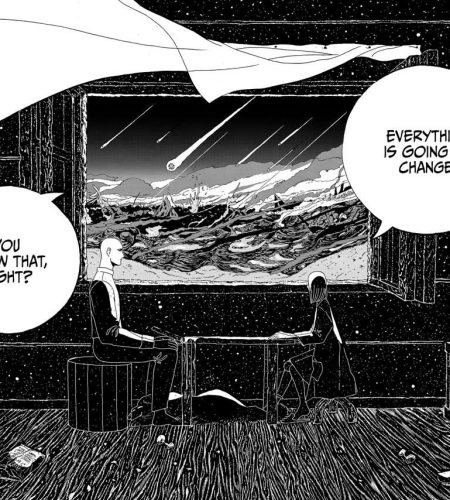
Ichikawa-sensei does not further elaborate on humanity's purpose in doing so, and the remainder of the conversation offers little additional information from which such a purpose could be directly inferred. One vague hint comes from Dr. Ayumu's remark: “How arrogant. This is simply nature… Everything will change.” She makes this statement immediately after revealing the central objective that shapes the human way of life, thereby expressing her rejection of the possibility that humans could ever achieve their goal of “rationalizing the universe,” on the grounds that the universe is constantly “changing.” Therefore, I personally believe that humanity's ultimate objective—one that runs counter to the universe's inherently ever-changing nature, in which nothing is eternal (at least at the level of its surface manifestations)—is to strive to discover eternity beneath that perpetually changing surface.
The attempt to cling to things that one knows will inevitably be buried by time—or “attachment”—is, according to Buddhism, what gives rise to human suffering. The “self,” on the other hand, is a particular subset of existences extracted from the larger collection of things that an individual cannot bring themselves to let go of, serving to define that individual's identity and distinguish the “I” from the vast sea of existences outside oneself that is regarded as “reality.” Yet the self is, by its very nature, a collection of particular elements belonging to reality. Therefore, if reality passes into the past—that is, disappears from the present—then the self constituted by those existences belonging to a bygone reality will also disappear.
And since humans are intelligent enough to understand that physical death in particular, or the disappearance of one property of a thing and its replacement by another in general, is something inescapable, the act of “searching for eternity beneath the ever-changing surface” of reality—that is, searching for an immutable principle or meaning underlying the very transformations in properties that all things undergo, thereby preserving the existence of the “I” as an eternal element belonging to an eternal principle—can be regarded as a means by which a rational species such as humanity attempts to escape from nothingness. Personally, I perceive this act as though humans were unilaterally constructing a subjective representation of reality within their own minds in an attempt to “eternalize” objective reality.
Based on Dr. Ayumu's subsequent statement that “humans assign meaning to everything precisely because they themselves are unreliable,” combined with Phos's realization, through Padparadscha, of just how easily the truth can be distorted, and their subsequent attempt to seek observational assistance from Cinnabar so as not to become carried away by their own “unsubstantiated” personal judgments, one could interpret this as follows: Having separated themselves from the rest of reality by endowing themselves with a self, humans simultaneously recognize that what takes place within their own minds does not necessarily correspond to what actually takes place in the external world. Consequently, when they unilaterally construct a rational reality within their minds based on their interpretations of what they observe in the external world, there remains the possibility that this self-constructed reality neither fully encompasses nor accurately represents the true nature of objective reality.
Yet preserving one's identity solely on the foundation of a subjective universe existing within one's own mind would not resolve humanity's existential problem. After all, if that universe exists only “within the mind,” would its representation of reality not be buried alongside the consciousness of its subject upon their death? The very essence of “constructing” a rational universe lies in “searching for” eternity within reality—an eternity capable of assuring humans that their meaning or role within objective reality will continue to be preserved even after their deaths. Then what assurance could a reality constructed by, and existing entirely within, the will of a finite individual such as a human possibly provide, when that reality itself would perish as soon as the individual died? That immutable eternity must have genuinely existed beneath the ever-changing exterior of reality from the very beginning, independently of any finite will. And the “subjective model of reality,” ultimately, is merely humanity's attempt to describe that underlying principle, as a means of confirming that, yes, such a “principle” really does exist. Only then would individuals possessing the skeptical characteristics of humans, such as Phos (after Lapis), accept that the principle genuinely exists and that there remains no other “possibility” capable of negating the immutability that this principle guarantees them.
But what if their individual descriptions are incorrect, causing their subjective models of reality to be refuted or to fail to correspond with objective reality? Then they are not real. Therefore, rationalizing reality within one's mind so that it conforms to, or can be substantiated by, objective reality itself—or, conversely, “rationalizing” objective reality so that it conforms to the reality existing within one's mind—is necessary for resolving the existential problem of an individual possessing an identity. In other words, what is necessary is to make the subjective reality within one's mind become one with objective reality.
And in the event that objective reality contains more than one individual who wishes to exert control over reality through the version of reality they have unilaterally constructed, while also seeking to control the remaining individuals by making them accept and enthusiastically proclaim a representation of reality that may not even be true, a struggle for power will arise. Such a struggle occurs when one individual, disagreeing with or becoming dissatisfied with the subjective reality constructed by the currently dominant individual through their rationalization of, assignment of meaning to, and exertion of control over objective reality, begins searching for flaws in the dominant individual's manner of rationalizing or assigning meaning to objective reality, before proposing their own alternative way of rationalizing or assigning meaning to that same objective reality.
Therefore, just as competition among companies selling goods drives their selling prices ever closer to the natural price of the products themselves, a rational reality unilaterally constructed by an individual, if it is to be accepted as the truth and thereby assimilated into objective reality, must be the closest approximation to objective reality among all the representations of the universe proposed within the community.
But as the doctor said, “Everything will eventually change.” Objective reality, at least in terms of its surface states that can be perceived through the senses, is constantly transforming. And with each such transformation, individuals who wish to preserve the identities derived from their own rational representations of reality must chase after it, continually refining their subjective realities so that they correspond as closely as possible to objective reality, lest they be left behind. For an immortal species, this would mean having to pursue objective reality for all eternity—precisely the kind of existence that is far from ideal for the Lunarians, who, as Aechmea remarked, had already “grown tired of evolving.”
And the social system headed by Kongo, within which the Gems live, has, whether intentionally or unintentionally, eliminated the very weakness that has tormented an immortal species like the Lunarians for so long: the fear of being left behind by reality whenever objective reality undergoes a transformation, a fear that has compelled them to rush endlessly toward the future.
Master Kongo, as the figure presiding over this society—and as one of the direct agents responsible for bringing the Gems into existence—has, through his “boundless love” and “boundless capacity to be loved,” established a model for rationalizing objective reality within the Gem Kingdom itself: objective reality, as seen through the framework constructed by Kongo, is confined entirely to that small stretch of land.
Because of the armor surrounding his body that evokes feelings of love, his power that is “so overwhelming that resistance is impossible,” and the fact that he is the one who brought the Gems into existence, Kongo becomes, in their eyes, the image of an irreplaceable parental figure, a “higher being” whom they can never fully comprehend but whom they are certain is far greater and far more knowledgeable than themselves.
Consequently, throughout the thousands of years in which Kongo's rational model of reality has prevailed, no one within the kingdom has been able to refute it, even if they wished to do so (as in Diamond's case). This is because none of the Gems believe themselves capable of refuting a rational representation of reality for the sake of which they were brought into existence, let alone one that every other individual of equal standing within the objective reality surrounding them has already accepted and enthusiastically proclaimed.
Therefore, the Gems who have been assigned their identities or positions within the kingdom by Kongo can simply cling to those identities for all eternity, without having to fear being left behind by objective reality anymore. After all, in their eyes, the barren stretch of land known as the “Gem Kingdom,” together with the closed cycle of endlessly repeating the duties assigned to them by their master for the rest of their lives, already constitutes the entirety of objective reality itself, as well as the most accurate rationalized representation of it.
As a result, there is no struggle for power here, nor is there any longer a need to engage in an endless race against objective reality. Instead, all that remains necessary is to continue fulfilling one's assigned role as well as possible, forever.
Returning to the comparison between humans and Gems, “eternity” here distinguishes the two species not only in terms of their lifespans, but also in terms of how they perceive the identities or positions within objective reality that define their respective selves.
While the Gems, like children who never grow up (both literally and figuratively, given their inorganic nature), live under identities belonging to selves that they regard as enduring unchanged throughout their entire existence, humans, characterized by “anxiety, unplanned expansion, competitive advantage, and unequal disparities,” as described by Phos, must live through the repeated collapse of their selves, brought about by the doubt that arises whenever objective reality exceeds the boundaries of their individual rationalized representations of it.
Sometimes, their former positions may subsequently be restored if they succeed once again in bringing the reality within their minds into unity with objective reality. At other times, those positions may collapse once more when their attempts fail.
The eternity—or the quality of remaining perpetually unchanged—of the objective reality surrounding them is something that individuals living according to the way of life characteristic of modern humans can never perceive within reality, no matter how desperately they long for it. And yet, that very eternity exists within the world of the Gems.
The self that a human individual uses to define themselves and distinguish the “I” from the rest of the reality surrounding them, as I have previously argued, is an embodiment of that individual's inevitably finite physical existence that is “potentially infinite,” employed as a means of resisting nothingness that has some possibility of succeeding, rather than struggling hopelessly against the inevitable death of their physical body. If this reasoning alone were to be applied, then the inorganic species in Houseki no Kuni would have no need for such a self, since they themselves are already infinite—at least according to the immature understanding of the Gems during their innocent childhood, when they have yet to comprehend the concept of “disappearance,” or, in other words, the concept of infinity becoming finitude. This means that they do not necessarily have to cling to a self belonging to some eternal, immaterial model of reality proposed by Kongo, regardless of how dissatisfied they might be with the identity bestowed upon them. Instead, they could simply continue living with the physical bodies they already possess. The same applies to the Lunarians—why must they pursue objective reality merely to rationalize the existence of such a self? Aechmea mentions that the reason is that they are compelled to live according to the “human way of life,” but what exactly is the human characteristic that still persists within the Lunarians and forces them to submit to this way of living?
The answer I personally propose is that the very nature of being “human” is already inseparably bound to that self-constructed, immaterial world. That the Lunarians possess characteristics entirely identical to those of humans is obvious enough to require no further discussion, since they are, after all, fragments of souls extracted from human individuals who have lost their flesh-and-blood bodies. But what about the Gems? They were brought into existence by Kongo alongside a society designed to eliminate the flaws of the former human society, in which individuals struggled against one another to protect the realities they had constructed for themselves, as well as the selves they had independently adopted to define their own identities. Yet, in the end, this society still allowed one particular human characteristic to take root and flourish within every individual Gem: freedom.
According to Aechmea, the most important thing Master Kongo bestowed upon the Gems was freedom, and this was also the only human characteristic that Aechmea ever invoked to establish a connection between the Gems and that bygone species.
The freedom of humanity that I am referring to lies precisely in the fact that humans are intelligent enough to secure a life sufficiently provided with the nourishment necessary to satisfy the basic requirements of a living organism's continued existence, while also being intelligent enough to recognize that, beyond trying to outrun death so as not to surrender to nothingness, attempting to run countless times faster than necessary in order to put nothingness so far behind them that it might one day become incapable of catching up is ultimately meaningless—because, in the end, it will catch up with them regardless.
Consequently, humans need only eat and drink when failing to do so would result in their deaths—running just fast enough to keep nothingness from catching them—rather than devoting their entire lives to searching for food, constantly running farther and farther away from nothingness. Humans are capable of accomplishing, within a mere fraction of their lifetimes, a task that other animals must spend their entire lives struggling to fulfill: running, running, and running away from nothingness—as far away as possible. This means that, once the portions of a human life governed by the necessity of “running” have been removed, whatever remains of that life becomes free, no longer governed by the need to run.
The important question, then, is this: If humans no longer have to run as other living organisms do, what will they do instead? “Anything they want” is the answer, and the existence of that seemingly endless multitude of possible choices available to humans—including the choice to continue running—is precisely what distinguishes humanity from the rest of nature. That is human freedom, and the very concept of being “human” is defined by that freedom.
“Humans” in the Bible are likewise described as having escaped God's control by eating the fruit of knowledge. And because the development of the natural World fundamentally arose from the fact that, since the earliest days of cellular existence, living cells had been nurtured along a single path—that of escaping nothingness by moving forward, since the very nature of existence is itself the complete opposite of nothingness—the countless other paths that humans are free to choose, existing alongside that primordial path, do not belong to the underlying principle or fundamental meaning inherent in this natural World. In his sermon on God's love, the priest in Vinland Saga argued that, so long as humans continue to live with freedom and the ability to choose their own paths, they will forever have no place to belong within nature—remaining unloved by God. And when they die, the free will that defines their humanity will disappear without meaning, leaving behind nothing more than a corpse in which the definition of being human no longer resides. As the priest explains, the organic remains of that corpse will continue performing the task that all life devoid of human will must perform: perpetuating the cycle of nature. The human will, meanwhile, will vanish entirely without contributing any meaning whatsoever to objective reality—the “position” within the natural World occupied by the freely chosen paths of humanity will add nothing to the beautiful World deliberately fashioned by God's own hands. For all parasitic creatures will eventually arrive at death, and once that long and arduous journey has been completed, every choice other than following the primordial path of moving forward will ultimately converge into one: In the end, all of them will amount to nothing more than “moving forward” toward the nothingness that awaits.
But regardless of all this, that freedom remains the very definition of the kind of creature that humans are. Humans still move forward according to their own desires, still choose different paths, and still independently choose their own “selves,” even when nothing can be extracted from objective reality to constitute those selves in the first place. Nietzsche's conception of the “Overman,” or Übermensch, rejects the notion that humans, having surrendered to the meaninglessness of their species' existence within objective reality, should accept the abandonment of their freedom and, in doing so, simultaneously abandon their existence as human individuals. Nietzsche believed that humanity would, without needing to depend on anything else, construct an overarching meaning for the entirety of the natural World with its own hands—a comprehensive meaning that would allow human selves to come into existence and, in turn, allow those selves to become a part of it.
From here arises humanity's unilateral construction of a rational model of reality—one capable of giving birth to, and accommodating, the selves formed through the paths they have chosen to follow—by “assigning meaning to all things and turning them into decorations” for a World that transcends nature, within which humans can confidently affirm that their selves, originally alien to and meaningless within nature, have truly acquired an enduring place. This particular means of escaping nothingness, distinct from that of all other living organisms and practiced by humans alone, ultimately cast a curse upon the inorganic species that had never possessed any desire to escape nothingness in the first place: It bestowed upon these inorganic species an immaterial self, separate from their inherently eternal physical existence, which they would then have to protect for all eternity.
Returning to the Gems, they were originally inorganic matter evolving along the very path prescribed by nature: “running.” But when Master Kongo appeared and fulfilled all their essential needs for sustaining life, that very abundance rendered their original objective of “running” unnecessary. By the time they had developed sufficient awareness to make choices according to their own free will, thereby forming selves for which no “self-constructed, rationalized reality” yet existed that could accommodate them, the threat posed by the Lunarians drove the isolated, distinct, and previously homeless selves of the individual Gems to unite in pursuit of a common objective: “protecting Master Kongo.” That greater purpose or meaning, which the Gems wished to devote themselves to serving, eventually became a new form of self-constructed representation of reality capable of accommodating the selves they carried within them.
Thus, the “Gem Kingdom” came into existence as a form of nascent society capable of taking the place of objective reality in providing a home for the selves born from the Gems' freely made choices: The self born from Red Beryl's choice to pursue fashion design, the self defined by Bort's exceptional combat abilities, and the self shaped by Rutile's desire to master the art of medicine could all coexist for the purpose of sustaining the functioning of Gem society. All of these selves existed beyond the physical matter from which the Gems themselves were constituted, and if those selves were removed, the inorganic matter left behind, however eternal it might be, would no longer be the “Red Beryl,” “Bort,” or “Rutile” that we have come to know.
And when Red Beryl, Bort, and Rutile decided to fight in defense of that society, it was their selves that they were protecting, rather than merely defending their physical bodies and the natural world to which those bodies belonged. (This is why Bort refused to question or act against the social structure of the kingdom, at least until their self began to develop [in the same way that the human self develops].)
I believe that the “curse” Aechmea spoke of is precisely the emergence of the “self” that an individual possessing free will must use to define the “I” in place of their physical existence. It is this self that has forced organic beings (such as humans), having overcome the pressure of protecting their physical existence, to instead endure the pressure of protecting their immaterial existence. As for inorganic beings (the Gems), despite their physical existence already being more than sufficient to satisfy their existential needs, they are nevertheless forced to anchor their identities in the image of an immaterial self that reflects their freely made choices, compelling them to continue protecting it.
The species whose way of life most closely resembles that of humans, the Lunarians, believe that their only salvation lies in “death,” which is also the one thing that allows humans to cling to their self-constructed, subjective representation of reality forever without having to follow objective reality, even though the changes or deviations from that subjective rationalized representation that objective reality undergoes over time are entirely perceptible to human senses. This is because “death” brings perception itself to an end. At that point, the final pieces of evidence from objective reality that their senses were able to perceive, and that could lend support to the model of reality within their minds, would be preserved forever. Meanwhile, any subsequent changes—particularly those that contradict their subjective model of reality or the immutable principle they themselves have constructed to explain reality—would no longer be received by them. Their subjective reality, along with the self extracted from it, would thus endure forever, never again to be overthrown (within their own minds). As for their physical existence, it would not matter if it disappeared—it was never what they used to define their “I” in the first place.
The Gems, meanwhile, do not understand death, or even the concept of permanent disappearance in general, whether applied to their inorganic bodies or their immaterial selves. As I have previously argued, the Gem society established by Master Kongo, when viewed through the eyes of an individual Gem, already constitutes the most rational interpretation of the entire natural World, and there is therefore no reason to change it. Without the pressure to pursue objective reality, the longing for a form of “salvation” such as death would be unnecessary, even if they were aware of its existence.
Fundamentally, there are two human characteristics that the Gems do not possess: A curiosity strong enough to make them willing to look beyond the constructed reality in which they live, and both the awareness of and desire for salvation through establishing an ending in which their selves would exist forever by bringing perception itself to an end through death.
So, does that mean Phosphophyllite possesses both of these characteristics? Personally, I believe that is precisely the case. But this essay has already gotten pretty long, so I suppose I'll leave that discussion for part two, ‘kay?
Subscribe to our email newsletter to get the latest posts delivered right to your email.
cốt truyện của bộ này có tính nguyên bản cao lắm đúng không? Bản sao gần nhất về nội dung với bộ này mà mọi người có thể nghĩ ra là bộ nào? Có 2 phương pháp thử nghiệm:
– Ta kể loáng thoáng 1 vài chi tiết cho người khác nghe và để họ đoán.
– Ta phân loại nó vào những đề mục khô cứng mà các bộ khác cũng sở hữu xem bộ nào có chung nhiều Tag nhất.
Tôi thấy Houseki no Kuni nguyên bản, nhưng có lẽ là do tôi coi chưa đủ nhiều
View on Facebook
phân tích được phết, để lưu lại lúc khác đọc
View on Facebook