
INTRODUCTION
“Vikings” is a term widely used to describe an ethnicity of Norsemen whose recognized identities are attached to the act of inaugurating the clouds of wars from Scandinavian regions to Europe, North America, New Zealand and Australia, while voyaging on large longships with dragon heads upfront. Unlike the occasional attribution people would usually make between soldiers— take, the crusaders— and the structure of society they are originally gathered to protect— The Holy Land, which would consequently allude the image of the bloody war fought by those soldiers to a following long-lasting peace to be achieved in protected regions, Vikings are constantly remembered as warlike savages whose lasting images and overall impacts left by the war they have participated in are collectively connected with nothing other than ferocity and death even though there is little difference in the brutality between the Vikings’ and the crusaders’ participated wars. Yet, such a judgement is not particularly inequitable.
Unlike the Christianity embraced by them Crusaders where there lies a shared vision of an eternal kingdom of God served as the foundation for every sacrifice they have chosen to make in war, Norse mythology, as believed by the Scandinavian Vikings, glorifies purely the warrior’s heroic death after a valiant battle without any greater good that might result from that sacrifice. Thus, for most people, once a Viking battle ends in bloodshed, nothing remains to be taken from it except the devastation it leaves behind.
The core reasons lie within the difference between these two beliefs at hand, where Christians regard the God who they are heading towards as the ultimate void— the perfect equilibrium of what we perceive as no-thingness— from which ordinary beings are derived by drawing a portion of that equilibrium into somethingness, and thus He cannot possibly die— that is, return from a distinct state of being back into the equilibrium of no-being, because He himself is already that ultimate nothingness; in contrast, the only Gods that the Norse has ever seek to lead their way are, however powerful, ultimately mundane entities formed within the broader realm of existence, who, though endowed with creative power, remain trivial compared to any definition of infinite equilibrium and are all destined to perish at the end of Ragnarök— the apocalyptic battle between the Gods and their Viking warriors. Consequently, in contrast to Christians, for whom every struggle carried in the blood is understood as a striving toward an eternal kingdom of harmony, where humanity exists in complete communion with their beloved God; Those bloodthirsty warriors of Scandinavia, following the conflict among the Norse gods, whose beings are wholly distinct from one another and who were all destined to perish once the sacred eruption of war had exhausted its fury and burned out forever, they will never attain an “eternal equilibrium” as a greater cause justifying for their battles, and instead would battling purely just because their belief essentially glorifies the instantaneous blaze of a brave fighter.
Yet is it accurate to claim that the Vikings had merely been mature enough to accept the inevitable nothingness ahead—where, unlike Christians who are embraced by its equilibrium, these Norsemen do not become one with an eternal foundation of “no-thingness” but instead simply cease to exist altogether— and consider this acceptable? If we interpret their choices this way, then the gradual adoption of Christianity by those once Viking at heart— whether voluntary or enforced by their new rulers, aiming to use Christianity’s emphasis on social order to build stable and complex societies under one shared “divine” authority— must have created a stark mental division between post-Christian Norsemen and their mythological ancestors in their views on how life should end, despite the fact that they were all humans living under the same lineage, right?
As a clue to that question, we can examine one of the earliest effective efforts to introduce Christianity into a society deeply shaped by the belief that all beings, like their many gods, exist in constant conflict and cannot coexist durably. In doing so, Canute the Great took on a role similar in influence to an omnipotent authority, presenting the Vikings with the concept of an infinite equilibrium and offering them a visible glimpse of the everlasting kingdom of God— under a shared divine authority that he himself upheld— as a goal for which they could intentionally devote their struggles.
The Christian model of governance, in Canute’s time, was more fully realized as an actual social and political order distinct from the older pagan tribal structures, rather than existing merely as a religious belief as it largely had under his predecessors. The displacement of Norse religion from a society shaped by bloodthirsty warriors, whose ancestral values had long been grounded in the mythology of Ragnarök, arguably became possible because Canute the Great’s supposedly boundless authority— or at least his image as a magisterial likeness of God— was presented and upheld so effectively before his courtiers that even those seemingly hopeless Vikings was convinced that the kingdom he had raised on earth could indeed grant them an eternal meaning. His apparent arrogance in likening himself to God is often illustrated by the story in which he attempted to command the tides to retreat, only to be comically overruled by the sea.
Assuming that the fundamental characteristics of human nature remain constant between the Norse who rejected Christianity and those of the same lineage who later embraced it, perhaps even the seemingly opposed understandings of what a human life ought to be devoted to— among Christians on the one hand and pre-Christian Norse believers on the other— can be interpreted as two different responses to a single, though deeply multifaceted, problem shared by all humanity.
What set these men apart in their opposing beliefs was not a difference in the fundamental problems they faced, but the varying importance they placed on comfort and credibility when deciding which belief was more compelling: Christianity offered the more comforting solution, whereas Norse mythology, though less consoling, may have appeared more probable to mortal perception. If this is so, then it becomes clear why strengthening Christianity’s appearance of trustworthiness— as Canute the Great did— would render Christianity the more compelling solution in the eyes of both sides, without requiring us to assume any fundamental change in human nature across the two periods.
And perhaps, once we identify the true nature of the “comfort” those Norsemen had always been striving for, we may recognize it as the very same comfort that humanity still seeks today— despite the differences in our beliefs as a mean to satisfy such a comfort, and despite the ways religion, ideology, and industry have divided us from one another. In this essay, the writer turns to the historical manga Vinland Saga, set during the Christianization of the Viking Age, as a lens through which we can examine an enduring source of human conflict across time. Through the path of Canute the Great, the essay explores what kind of comfort that human conflicts— from the Viking Age to the present— have continually sought to secure for one’s self for thousands of years.
It then considers how that persistent “lack of comfort”, which this essay will describe as a “lack of love”, might be overcome in order to break the cycle of war, by walking on the path of Thorfinn Karlsefni, whose journey toward the promised land Vinland may be interpreted in light of the ultimate solution offered by Christianity.
THE PATH OF CANUTE: WHEN THE DESIRE TO BE LOVED BECOMES THE ROOT CAUSE FOR CONFLICTS BETWEEN MEN AND THE EMPEROR WHO TRIED TO GIVE LOVE TO HUMANITY.
1.1. Context
In the first six pages of chapter 37 of Vinland Saga, the author Yukimura Makoto spends the first three pages depicting the scene where the Vikings on Thorkell the Tall’s side use the corpses of another group of Vikings they just killed as toys for entertainment, while the next three pages show how they appropriate the remaining possessions left on those corpses as their own. Both the act of killing and the act of reusing the property of the dead are precisely the things that the now-dead Vikings had once done to those they considered enemies; and they are also the very things that the currently triumphant Vikings will eventually experience when the day comes for them to die at the hands of others.
Much like the vision of the human world revealed in Thorfinn’s nightmare, warriors across generations have been trapped in such a repeating cycle: one person kills another in the hope of claiming from the corpse a “medal” that proves their worth in life, only to wait until they themselves are killed so that this same medal can be carried to Valhalla and presented to the gods. The physical remains left behind in the material world then become new medals for the next generation of Vikings to seize, and when those warriors die, the process repeats once again.
Does not the very fact that this is a self-contained cycle imply that every medal awarded merely signifies that it was first taken from another, only to be passed along in turn to sustain the illusion of genuine gain? A Christian fellow Ragnar, in Chapter 21, regards it as ultimately meaningless. To him, devoting one’s life to combat in order to prove one’s worth to Death— only for that worth to be erased at the moment of defeat— is profoundly empty. Thorkell, however, offers a contrasting view: these very ‘medals,’ surrendered to Death upon meeting him, determine the role a warrior’s soul will assume in the immaterial realm of Valhalla. Should they reach Valhalla and stand as mighty warriors alongside the divine, then when Ragnarök arrives and their existence ends once more, all things will end with them— Nothing will remain to outlast or abandon them. Thus, what occurs in the mortal world, and what persists after death within it, is of no consequence. What matters is the manner of one’s death and the existence that follows, and not the life presently being lived.
At the end of chapter 37, Canute views this as the way a species that has lost “love” after eating the forbidden fruit struggles to regain love from God; and, just as Valhalla is believed to exist after physical death and all things are destined to end in a final blaze of fire, humans can only regain the love they have lost after they die. The future king believes that it is precisely because of the lack of love in this pure world of nature that humans have been driven to blindly seek for any possible transient meanings on earth through the mean of wars— meanings that will later be overthrown— only to cling to a vague belief in either a “Kingdom of God” or a mighty “Valhalla” above nature where people like them can finally receive love after all those sacrifices. Compensating for those warriors’ hopeless marching towards doom in hope of something meaningful will bloom after their death soon becomes the central driving force behind Canute’s decision to build a “heaven on earth” in the form of a mighty empire, all for the purpose of “giving a lasting meaning to the deaths” to the warriors instead of the vicious cycle of those warriors fighting to [receive meaning (the medals)] and then [have the meaning (the medals) taken away], as seen in Thorfinn’s nightmare.
Basically, that is what the manga states explicitly to the reader: The lack of love in humans is the root cause of conflict, and the birth of the mightiest empire— serving as a heaven on earth to replace God’s heaven— is the solution Canute proposes to save them and bring “peace to all.” However, interpreting those heavily metaphorical images imposed on humanity, such as “lacking love,” into a universal problem that readers can directly relate to reality remains a highly controversial issue within the Vinland Saga fan community; and it leads to the community not being able to reach one unified interpretation of the reasoning behind the path Canute chooses to end humanity’s “lack of love,” nor of the “connection” between Canute’s heaven and that of the protagonist Thorfinn. And I myself am one individual within that community, with my own interpretation of the “love” Canute speaks of and how it can be linked to his later choices.
1.2. Canute’s path
Chapter 37 is titled “The Definition of Love” and its central content is the conversation between Willibald the monk and Canute— who at that time was still a prince. Canute previously believed that Ragnar was the only person in the world who still loved him, and the priest responds to that belief by saying that the emotion Ragnar felt toward Canute— similar to the loyalty slaves feel toward their lord or the bond between the warrior brothers Thorgrim and Atli—is not love but “discrimination.” The reasoning the monk uses to support this claim is that, just as Atli would only protect his brother on the battlefield and would never extend that concern to a stranger, Ragnar sacrificed the lives of sixty-two men for the safety of the prince he favored. That is “discrimination” and— contrary to what most readers think— “love” in the monk’s mind is something objective and far less impermanent than when it is forced into the subjective framework of an individual human being, since an individual human is bound to die and so is that subjective framework (This description of “discrimination” can also be linked to the fact that any possible meanings coming from the warriors’ medals would eventually “die”/ fade away into nothingness as soon as the warriors’ glories are outdated/ overthrown by other living men=> Impermanent, unlike the stable objectivity of “love” that the monk mentioned.)
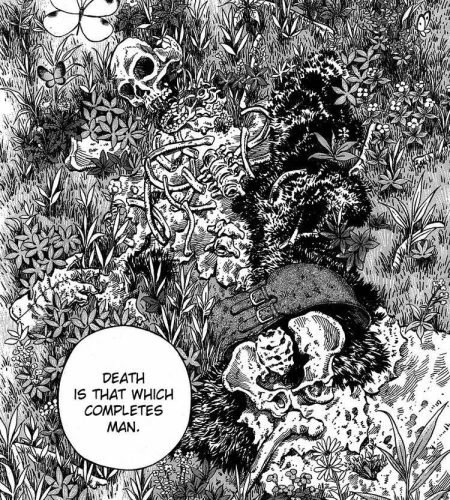
The closest and most relatable example for humans of the kind of love that monk Willibald describes is the corpse of a fallen warrior lying alone on the snow. “Because that warrior is already dead, he will no longer hate, kill, or steal anything from anyone. His body will be left here forever, and the remaining flesh will allow the living creatures around him to fill their stomachs. No matter how much storm and rain pour down on him, he will not utter a single complaint. Isn’t that wonderful?”
At this point many readers might think: Isn’t the fact that the warrior’s corpse lies there passively to be exploited until nothing remains by the environment simply because he no longer has the ability to resist? He is not voluntarily giving that so-called love; he, like the other examples of love the monk gives— the sky, the white snow, the blowing wind—does not decide to give anything at all but simply remains forever in the default state nature gave him, and ultimately cannot give “love” in the sense that humans long for and can actually feel. I mean, what human would want to be “loved” in that way— when everything around them merely exists indifferently as it naturally is instead of giving them special esteem beyond the ordinary? And if “love” is something so mundane, then why does Willibald the monk claim that humans fight each other essentially to seek it?
According to the writer’s interpretation, yes, the love that Willibald describes is not what humans desire— or more precisely, humans are no longer suited to feel “loved” by that kind of love. That is why they fight to find a substitute love capable of truly giving them the feeling of being loved. Which means, in the end, there must still be another “more primitive” definition of “love” that even the love that comes from pure nature itself cannot fully encompass— what is it? What is the primitive longing in that long-lost “love” that warriors have had to sacrifice their entire lives to find a replacement for? Based on the story of humanity’s fall that is directly incorporated into monk Willibald’s sermon, “love” here, in the writer’s view, is fundamentally the feeling of belonging—like a screw belonging to a larger machine and contributing as one part of that machine’s operation; or conversely, the feeling that one’s existence does not fall into nothingness/does not belong to nowhere even after they had died, but instead still leaves a lasting value on the on-going reality. Simply put, seeking love is equivalent to seeking a long-lasting figure that would represent one’s own physical existence and extend its impact beyond the death of oneself.
Let’s apply this theory onto story of Vinland Saga: The cover of chapter 37 “The Definition of Love” is the image of Adam’s hand reaching to pick the fruit of knowledge, the thing which had— according to the Bible— introduced into the primitive awareness of humans that God had originally equipped only with “good” with a knowledge of “evil.” The “good” here, when fitted into the examples of love that Canute gives such as snow, sky, or wind, is the necessary awareness for the creatures God created to fulfill their role in maintaining the beauty of nature. In contrast, “evil” is the superfluous awareness that contributes nothing to the operation of nature nor to the predetermined end it is destined for, and is therefore prone to vanish as soon as its physical end arrives.
Nature’s basic operation is governed by a single mechanism. From the moment living beings become conscious, they share a common impulse to resist nonexistence and to pass on, through natural selection, the genetic traits most closely aligned with that impulse to future generations, so that the qualities that define them are not swallowed by nothingness. As living beings evolve and non-living matter is continually altered through the protein exchange made between them and other living beings, the structure of nature itself evolves through the mechanism often described as “survival of the fittest.”
In this process, organisms whose traits most effectively sustain their own existence while allowing them to integrate with their surroundings are more likely to endure. Through their interactions with the environment, living beings both imprint their existence upon inert matter by transforming it and draw from it the proteins that sustain their own existence; those best adapted to this reciprocal relation are preserved. Their genetic traits are then carried into the future, where they continue to be adjusted in response to the changing conditions of each new stage in the natural order until it reaches its final destination.
This evolution process [based on “survival of the fittest” mechanism where those beings who inter-contribute well with each other are kept to form the overall structure of God’s nature (similarly to how the sky, the snow and the trees work well together and contribute their harmony to the beauty of the natural world)] is how single-celled organisms evolved into multicellular ones, how simple cells evolved into living creatures, and how living creatures evolved into humans. But when it reaches “human,” a problem arises.
As many readers may have noticed, the individuals who love fighting in Vinland Saga—and most humans in the modern world— do not spend their entire lives foraging, interacting with beings surrounding them for the sake of being the “fittest”, or laboring to reproduce in the hope that they are passing down their suitable genetic traits to their offsprings so that it won’t fall into nonexistence the way other animals do. With the intelligence they are said to have stolen from God, the remaining time in a human life is no longer spent solely on escaping nothingness as it should be, for two reasons: Humans are smart enough to realize that death is inevitable and that simply preparing enough food to satisfy the primitive craving not to be caught by nothingness is sufficient—they do not need to spend far more time than necessary continuously staying further and further ahead of nothingness. Humans have already fulfilled the primitive duty of living that other species must spend their whole lives performing in less than 1/10 of their lifespan. So what should humans do with the remaining time? Anything, of course.
Humans are free entities, especially when they become aware of both good (living as God/nature decrees) and evil (anything that deviates from those listed as good), while retaining the right to choose between the two paths. And once they have evolved beyond the control of the good and entered the realm of evil, the evil that individual humans choose to follow will by nature not belong to nature nor contribute anything to the beauty of this natural world.
In monk Willibald’s sermon on love, the writer interprets the general meaning of what he says about the intelligence that humanity’s ancestors stole from God— leading to both being expelled from paradise— as follows: as long as humans live with freedom and the ability to choose their own path, humans will forever have no place of refuge in nature— they will not be loved by/ accepted as a part of God; and when they die, the free will that defines them will vanish into nothingness, leaving behind a mere mindless corpse. Taking the example of the fallen warrior’s corpse again: the remaining organic part of his dead body will continue to play the important role he left unfinished in maintaining the operation of nature, while the free will of the warrior will dissolve into nothingness and never contribute anything to the beauty of the natural world.
But no matter how unnatural it is, free will remains what defines both the concept of humanity and the individual self of each person; and once it is abandoned, humans will no longer be human, I will no longer be me, and you will no longer be you. And yet, even though humanity has evolved themselves to an extent that lies far beyond the control of nature, the primitive craving to be “loved”/to be accepted as an existence with lasting meaning still remains within us, so much that the wandering individuals on earth unilaterally transform the sole mechanism of “survival of the fittest” and the sole predetermined final destination “where their genes are passed down towards the end of time” by which nature originally operates itself into substitute mechanisms that are capable of including their free will.
In other words, at this point humans— rather than relying on a nature that originally has no place for them— construct a replacement “nature” with its own operating mechanism and final destination that has room for a species like humanity to participate in. Human society or human civilization as a whole that we are experiencing today can be considered one of the consequences of this move by humanity.
However, unlike the good which possesses only one path/ one mechanism for all things to parasitically follow in peace (take the sole “survival of the fittest” path/ mechanism, which encourages living beings to all seek for energy and pass down their genes to shape one shared on-going structure of the natural world for example), the definition of evil is simply a collective label applied to all the paths that are not considered as the path leading to the good. Therefore, although they are all labeled “evil,” the countless completely independent paths freely chosen by humans are very likely to conflict with one another, and the new mechanisms and meanings that one group proposes to replace nature’s original mechanism and meaning for the whole society to follow are very likely to fail to satisfy the countless separate selves, with countless separate ideas that the collective of humanity currently possesses.
The difference in what mechanisms and meanings that each individual wants to assign onto the natural world consequently causes that earlier shared societal structure to be divided into many separated smaller societies. And just as individuals with separate identities have separate roles within the society that they belong to, each society also owns for itself a role—no matter how large or small— belonging to a larger collective structure called the human world (replacing the natural world).
Things seemed to go well— humanity had their own substituted world that they could call themselves a part within. Yet, just as each human individual can develop/gain the vision to develop beyond the scope of nature, they can also develop/have the vision to develop beyond the society they belong to too, since, well, the number of paths that humanity’s free will has the right to take is too many to be completely crammed into one specific societal structure; And at such a point, that common established structure can therefore be demanded to change by those who ended up developing out of its scope and can no longer place themselves within such an outdated structure anymore. This, in my view, is precisely how conflicts between men originate: When a society grows beyond the role it originally accepted in order to coexist harmoniously with other societies, it inevitably disrupts the existing balance and begins to demand changes to the overall order of the human world.
At that point, two possibilities arise depending on the response of the remaining individuals or groups— those who are satisfied with their current roles within this contemporary societal structure: One, may either accept the change at the expense of allowing their current positions to be destabilized; or two, resist the demands of the overdeveloped group in order to preserve their own peaceful lives. “War” in Vinland Saga is the result of the satisfied groups that choose to resist. When opposing individuals or groups within the same society or world cling to irreconcilable desires, conflict is born, and they can never coexist in wholeness— which is precisely why humanity’s definition of love is so a much associated with discrimination, as in order for a person to feel “loved”, their values have to be accepted as an inseparable part of the overall structure of the natural world, which will likely result in other opposite values and other possible structures being ignored=> Discrimination, which depends on conflict and the suppression of opposing sides to sustain itself, and is therefore inherently impermanent.
To realize/ make one’s own desires become parts of a human world full of irreconcilable desires, each society creates new roles dedicated to fight opposing desires and make room for its own. Warriors emerge to serve this purpose. And the only way for a warrior’s self to be loved within their society is to successfully realize that society’s desires.
The problem, as everyone knows, is that in such wars, what benefits one side harms the other, even though both have sacrificed so much to realize their desires. Thus, regardless of who benefits, the “new society” born from the victor’s desires will exist only temporarily, until the defeated side rises again to reclaim victory. Then the roles reverse, and the cycle continues. Both sides want to give meaning/ give “love” to what they have sacrificed rather than letting it fall into nothingness, but only one side can succeed in any given war– only one stable “human world” is allowed to be built up. As a result, both are forced into accepting temporary victories, and the meaning granted to their sacrifices— including the lives of warriors— exists only until it is overturned.
It is impossible to know whether the leaders who choose war and achieve victory in Vinland Saga see that victory as temporary and ultimately destined to be lost. But at the very least, the warriors under their command largely do not expect the roles they sacrificed their lives to earn, or the “new society” born of war, to outlast their own deaths. As Thorkell and others repeatedly say, they look not to the fragile permanence of the real world, but to the world after death—where the gods will record and preserve their roles eternally in Valhalla. Thus, instead of being “loved” in reality, their warrior selves will be “loved” in Valhalla.
Canute’s assertion that humanity can never attain love without abandoning its humanity– without accepting to just let go of their human selves and die– is correct when viewed from both the human and natural perspectives.
1. From nature’s perspective, humans can only become part of creation’s beauty once their alien selfhood disappears, leaving behind a mindless body that follows a single path toward the good.
2. From humanity’s perspective, the death of consciousness is the only thing that prevents humans from endlessly pursuing the potentials suggested by free will, only to lose them when different free wills fall into collision. That is, the death of a human’s consciousness will allow a warrior to forever drown himself in his own knowledge that his own desires were realized, without acknowledging any of its later overthrow made by other living enemies after his death.
In short, to love and be loved, humans must give up being human.
Canute sees this as God’s punishment, and sees the life [filled with freedom/ filled with the tendency to defy every stable structures and soar beyond them, yet was still mentally bound by an endless yearning towards a stable structure/ permanent love] of humanity as nothing but a “trial” imposed by God, one that must be overcome. To abandon the self born of free will is, in this view, the path to salvation. Canute rejects this. His central goal after ascending the throne is to build a true paradise to replace God’s heaven, one that can give love to humanity’s many lost selves that God had long encouraged to be abandoned through death.
The fundamental reason that humanity’s substitute mechanisms and meanings repeatedly collapse is that even after choosing a path, building a stable society and defining one’s selfhood with a role within that society, humans still tend to look beyond it to distant paths they “have the potential to achieve,” just as they once saw paths beyond the good God assigned them. The indeterminacy of this “potential” within countless individuals, placed within the same world, inevitably leads to conflict, since not all potentials can be realized simultaneously.
Recognizing potential itself is not the problem. Potential is not inherently part of one’s selfhood that must be realized within the world yet. The problem arises when humans misjudge the feasibility of a potential and gamble the stability of their current established roles on realizing it. When potential becomes a substitute goal/ meaning meant to compensate for an already lost self, humans are compelled to realize it at all costs to avoid that lost self falling into nothingness. A clear example is Einar and Styrk’s justification for continuing the war in Vinland—to give meaning to what they had already sacrificed—which also motivated the settlers’ faction to keep fighting.
Misjudging the feasibility and gambling on an unrealizable potential stems from the inability of countless human minds to think in unison, and from the impossibility of knowing the limits of others or how far one can push them. Canute’s solution is to strip individuals of their right to [gain power and unilaterally start wars in order to realize their own potential while staying ignorant of how far the opposing sides will take to prevent them from succeeding], and instead, he himself will concentrate all of the power into his own hands, a power so large that can lend him the right to decide which potentials will be realized solely by his own will. His subjects may propose potentials, but only he gets to decide which are enacted. This move unifies previously separate societies into a single, stable human world, preventing capable groups with competing visions of ideal societies from eliminating one another. Through this, no societal structures, mechanisms or ultimate meanings will be overthrown by the unchecked development of the minority anymore; no warrior will die meaningless deaths anymore. That is Canute’s ideal.
“Look at us, Thorfinn. It is Vikings like us who have brought chaos to this world. Do you think people like us deserve a place in heaven? And yet, that is precisely what makes us human. To stray from the path of the good and become lost—that is the condition for a living being to become human.
Humans cannot be saved by obeying God’s laws. Therefore, to create a paradise on earth, we must oppose God. Yes, I am the leader of the Vikings. I rule and lead these people. I unite their strength.”
And to become the one with the authority to command the strength of all humanity, Emperor Canute must be strong— strong enough to force humanity to abandon their own desire towards realizing those personal potentials suggested to them by free will, and strong enough to subdue even those who value the integrity of self-determination, like Thorkell or Thorgil. Yet, it still seems as though Canute is guiding humanity into the very trap he once rejected — a state where humans are stripped of the freedom that defines them. His “paradise,” then, appears to resemble God’s heaven: a world in which humanity surrenders its free will and simply conforms to roles imposed from above, much like the unthinking creatures of nature — the very existence Canute himself once refused to accept.
Honestly, when Yukimura-sensei drew the parallel between Canute’s path and Thorfinn’s, and when Thorfinn himself stated that the path he envisioned could patch the hole in Canute’s, I believed Thorfinn’s goal was to solve the problem of lost freedom that is inherently a part of Canute’s model of rule. For example, Thorfinn suggests that since everyone in a society affects and is affected by others’ free choices, it is necessary to set limits on free action to prevent conflicts of interest and enable peaceful coexistence. In that case, limits would not come from a superior authority like Canute, but from placing free wills in close proximity to one another.
But reading more carefully, it seems that reconciling free wills may actually be Canute’s task as well—especially after his peace negotiations with Thorfinn at the end of the Slave Arc, when Canute chooses not to coerce his subjects with power but instead allows them to decide freely how far are they willing to push their boundaries with the King.
So then… What exactly is Thorfinn’s goal?
THORFINN’S PATH: WHEN THE DESIRE FOR LOVE BECOMES A CYCLE OF ENDLESS STRUGGLE AGAINST ONE ANOTHER OF HUMANITY— AND THE ATTEMPT TO BREAK IT OF A MAN.
2.1. Context
In the upper analysis, I attempted to connect His Majesty Canute’s vision of the fundamental cause of humanity’s suffering with the solution he proposed to eliminate it while still preserving the very free will that defines a human. Based on the story, I essentially argued that the root lies in humanity’s primal, yet perpetually unattainable, yearning for “love,” and that the feeling of being loved, of being part of the natural world created by God’s hand, can no longer be felt by the heart of a species expelled from the Garden of Eden like humanity.
As the intelligence that humanity stole from God has given them freedom beyond what creation has ordained, the self that defines a person’s identity also develops beyond the role it was originally assigned by creation => A person’s self will therefore forever be outside of nature and not be accepted/loved by nature anymore. Consequently, an emperor like His Majesty Canute must take on the responsibility of giving humanity an alternative “nature” capable of encapsulating all of those heterodox self that God had abandoned into its long-lasting operation
But clearly, this proposed solution has flaws. By giving humanity an alternative societal structure substituting the original structure of nature initiated by God in hope that it can contain their overgrown selves, His Majesty Canute will just end up placing humankind in a cage larger than the cage from the original natural world that God himself had forced all creatures to reside in. And just like how the original self that humanity once held grew beyond the confines of the natural world created by God, that already enormous human self, when once again being placed under a larger societal structure built by His Majesty Canute himself, will ultimately grow even larger than the alternative structure that contains it. And just as how humanity had rejected the limitations imposed by God’s “natural” cage in order to realize the potential suggested by their free will, when trapped within an even larger cage of society in substitution for the natural cage created by His Majesty, that potential self suggested by humanity’s free will will once again grow beyond its scope and consequently require a larger cage to encapsulate their now larger selves fully. Then, just as before, the “substitute cage” constructed by each individual will in turn overthrow one another until nothing remains.
Instead of imagining it as nothing more than Thorfinn’s dreamlike Valhalla, the ideal path, if still following Canute’s proposed solution, would be for His Majesty Canute to successfully gather all the free will of his subjects, organize them, and cut out the parts that would conflict with each other when coexisting in one society. From there, the limitations imposed by the alternative container of society on a free individual, instead of existing as a law from above—which would contradict free will—would become a necessity when many free individuals are placed within the same environment together.
If this alternative cage, intended to stifle the potential arising from human free will, is truly created from inherent limitations such as “other free wills existing in the same space,” then it might convince the rest of humanity that they cannot possibly transcend it to sustainably realize even a larger size of their own selves in this world anymore. Since the peace negotiations with Thorfinn, Canute has pursued this path, attempting to become a mediator capable of resolving conflicts between people. However, in his final appearance three years later, it is clear to the reader that he has not yet succeeded. And if history is correct, even after his death, or even a hundred years after his death, no lasting structure of society has been established among humanity, in substitution for the now outdated structure of nature.
Thorfinn himself experiments with this idea— most clearly when he argues that if groups within a single community, each holding different notions of freedom, can establish a shared boundary— one whose violation would harm all sides—then truly free individuals will, over time, accept that boundary as the endpoint of their freedom. In that sense, freedom finds its limit in mutual recognition.
Yet whether those captivated by the possibilities of free will would genuinely accept such imposed limits as “real” is far less certain, as doubt will inevitably seep in. One possible doubt may be that if one side crosses the agreed boundary— say, by seizing a negligibly small part of the property claimed by the other side, will the wronged side consider that loss as significant as they did when the agreement was made at the negotiating table, and will they truly follow through on the mutually assured harm as they had declared semantically so? This uncertainty exposes a gap between the declared limits and those of actual ones, and that the boundary articulated in an agreement made verbally on table may not coincide with the boundary enforced in practice. And within that gap, “potential” persists: there would still be room for the self to develop further rather than having reached its final boundary.
Of course, over a span short in comparison with the length of a human life, it is possible that humanity, after enduring enough suffering and after spending ages testing one another through conflict, may eventually arrive at a shared understanding of the limits between them, and accept the latest boundary as a way of preventing further needless sacrifice. However, it is uncertain whether, after the present-day generation of humans die and this peaceful societal structure is gradually filled by entirely new individuals, the consensus on limits that existed only among the deceased will continue to be believed in. If not, it will be overthrown, war will break out to rebuild a more up-to-date societal structure with new limits, and after a century or so, that structure will be overthrown again, condemning humanity to repeat the same old cycle.
Before speaking of the alternative solution proposed by Thorfinn, it is clear that this is not the first time a person with power like Canute has held the ideal of building a heaven for himself rather than relying on God—especially when the longing for a paradise on earth, as well as the effort to construct it within human beings, can be clearly seen through the countless wars between humans throughout history aimed at building and preserving the survival of the society to which their selves belong. At least in Vinland Saga, the portrayal of kings and the warriors under their command, as well as the image of children viewing becoming a warrior as a necessary rite to “make a name for themselves” in this society, already demonstrates the prevalence of that ideal. But all of it is ultimately because of reasons such as not being able to understand one another, or not being able to preserve that understanding over time, that even if a paradise could successfully be created and the present self of human beings could be loved, that self would still continue to develop until it surpasses that self-made paradise and once again demands war in order to give rise to yet another new paradise, and another, and another still. Only the death of consciousness can prevent humans’ mind from ever generating more potential selves to be realized, from continuing to chase the potential suggested by free will within them and only death can bring an end to this cycle of being loved, not being loved, and being loved again.
But that also means accepting a fleeting kind of love that can only exist in a person’s mind and will disappear once they die (alluding to that impermanent “medal” that those warriors had come to terms with). Neither the feeling that one’s own self is loved nor the structure of earthly paradise which bestows love upon humanity can endure outside of objective reality. Every struggle to bestow eternal love upon the human self fails, all because the human self must continue to develop. So how can we stop it from developing? Can we just eliminate the potential that free will suggests to humanity, or eliminate the very free will that defines a person’s nature? Just like how Thorfinn in the Prologue arc choosing to abandon his own free will to transcend the warrior society he hates simply to fulfill his role well, without considering how he would live if that society or his role ended; or like Gudrid, if she chose to give up her own free will to see the wider world and instead just threw herself into the role of wife that the Icelandic social model assigned to her?
From my perspective, Vinland Saga does not embrace those methods, and even the teachings of God that Thorfinn overheard— the foundation he relied on most when developing his solution to create a paradise with his own hands— contain absolutely no such implication. And instead of encouraging an abandonment of one’s self, it aims to encourage people to let go of the idea that they possess a separate, independent self distinct from the rest of reality.
2.2. The fundamental problem in human nature that Thorfinn needs to tackle
Remember the monk’s argument that what people call love is actually just discrimination? The most suitable explanation shall I come up with for this view is that from the very moment when consciousness begins to emerge within a living being, it becomes aware of a distinction between itself and the rest of nature— that the state of its own existence is not identical to that of the world surrounding it. This very awareness compels them to fight each other for survival in a food-limited environment– they must protect their selves from being driven to death by other life forms also yearning for life.
This awareness of a “me versus them” or “self versus enemy” relationship is, in this view, the principle that drives nature from its beginnings to the present day, and it is also the principle underlying the birth of every living being in the Garden of Eden as described in the Bible. For that reason, when all species follow this principle and leave behind traces of their existence as one stage among the countless stages in nature’s endless process of evolution, they become an inseparable part of that process. And since nature is itself an indispensable part of the Garden of Eden and the Garden of Eden itself is shown to possess creatures that can only be achieved through evolution, it follows— as concluded in the part I above— that when living beings fully realize their instinct to survive for the sake of evolution, they will be loved by nature just as they are loved by God in that Garden of Eden. But strangely, according to the biblical description of the Garden of Eden, the species within it live together harmoniously, rather than fighting for survival as they should have done to achieve evolution.
“The wolf will dwell with the lamb, the leopard will lie down with the goat. The calf and the lion and the yearling together, and a little child will lead them. The cow will feed with the bear, their young will lie down together, and the lion will eat straw like the ox… They will neither harm nor destroy on all my holy mountain, for the earth will be filled with the knowledge of the Lord, as the waters cover the sea.” (Isaiah 11:6-9)
As described in the Bible, the animals living together in the Garden of Eden did not struggle against one another for the right to exist; instead, they lived in harmony. The Bible says they did not do so because they possessed the “knowledge of God.” So, what can this information possibly be interpreted in the case of Vinland Saga? In order to dissect this unexpected correlation fully, the writer henceforth will draw a clear distinction between “being loved” and “being aware of being loved”.
Every creature that exists on earth, however fleeting or parasitic its life may seem, inevitably leaves traces upon the world and becomes part of nature’s ongoing course. In that sense—if we speak purely in terms of material existence—each creature is, in fact, already “loved” by nature, insofar as the impact it leaves upon the ever-unfolding continuum of evolution is sustained, absorbed, and preserved within it. Yet this love goes unrecognized. Creatures do not realize that they are already loved, and so they turn against one another in an effort to retake that very love back for themselves. And, it is precisely this ignorance that has gained them “love”:
During the process of spending their whole lives eliminating those who they regarded as rivals, those mindless animals one by one have all participated in operating that “survival of the fittest” mechanism of the natural world without even acknowledging so. As a consequence, those animals’ very act of struggling is what would represent the inseparable impact of their existence left onto nature itself—and thus, paradoxically, their very act of seeking for love will precisely be the means by which they are “loved.” The conclusion, then, is that all earthly creatures have always been loved from the very beginning. But because they lack awareness of that love, they are unable to live in harmony. Such harmony, the writer suggests, was only possible when they still possessed the sacred “knowledge of God.”
And unlike those animals, the superior intelligence that mankind had stolen from God is prosperous enough for them to realize that the role of operating the natural world is undertaken by every living individual with a pure will to live, and that their mere existence leaves a mark on nature that will be forever preserved/loved. The natural cycle of hunting and being hunted, instead of a life-or-death struggle between friend and foe to gain a position in nature where one’s self can reign, is actually just all parties playing their roles in positions that already exist throughout the endless lifespan of nature. Ideally, an individual’s perception of the rest of nature would have no reason to see each other as enemies or themselves as a solitary entity defending themselves against the rivalrous development of other external individuals around them, because all of them are companions, and no matter how far apart they may seem, they are all working towards a common goal. All creatures fail to recognize this and continue to fight for the sake of their own ideas of a self to be preserved within nature (without realizing that it was already accepted by nature from the beginning), mistakenly viewing their companions as enemies. Therefore, the monk calls them “discriminating” instead of “loving”. Thus, while living beings in general are “loved” by nature and God, the majority of them are unaware of being loved and, consequently, do not know how to love. It is no coincidence that among God’s creatures, as Canute considered “knowing how to love”, there is not a single living being with a distinct individuality (the snow, the wind, the sky, those are all inanimate entities).
Based on that principle, we can say that humans are even more capable of loving than many other animals with individual consciousness, because humans have recognized the love that nature bestows upon their physical being and have therefore chosen to end the struggle and no longer strive to find a place for it anymore. However, at this point, what the natural world loves is limited to the material existence of all things, something we have long known is no longer sufficient to represent the self of an individual human being. Even so, it is precisely the limit to the love that primitive nature can bestow upon all living things. Humans, therefore, fall into another cycle of struggle to find an alternative nature capable of containing the remaining immaterial self within themselves, as the writer has outlined above. A person with a newly expanded self will then transcend the natural image where their physical self has known both to love and to be loved, and return to a state of complete detachment from love.
“Potential”— meaning the ability to imagine a future that could be different from the one already laid out before us— is a weakness of human beings. The basic logic behind human suffering is almost the same as in other living beings: all of them want to be loved, yet none of them can fully obtain that love. The only real difference is that humans can recognize the love that nature gives to their physical existence because they are aware of a future so far ahead that they can almost reach the end of nature’s endless journey.Yet, once a person has formed an image of the path their present self is meant to follow in order to complete the role that the structure of nature had originally assigned to them, their free would still remain nonetheless. And therefore, it would still give them the power to decide which path to take among countless potential paths lying contemporaneously to the path that a current determined structure of nature laid out for them.
For other animals, which have not come to understand this, the act of simply yielding to the raw impulse to live— choosing the original path without being burdened or discouraged by any foreknowledge, as humans are— can be seen as a direct expression of the self born from their free will. In such a state, their identity becomes indistinguishable from the very path laid out by the structure of nature itself, and their role within the vast expanse of nature is nothing more than the purpose that path is meant to fulfill. But if a person realizes that this path “already existed from the beginning”— that is, it was already meant to belong to, and be loved by, a larger being that existed before the moment their choice to actually take that path was even made— then their self can no longer be defined by that path or by the role it serves anymore. That feeling of being abandoned by one’s own free will and by one’s “true” self is like being shown a detailed blueprint of your entire future life — from every personal gesture and word to every outside influence — starting from now. So where do the other possible paths go, the ones your free will truly wants and could actually reach, if they are not part of any system already defined for you? Into nothingness.
So, if an individual suddenly realizes that its current self is being loved, then suddenly, that self… will no longer be its old self, and it must once again seek love for its new self, repeating this cycle. Perhaps this is the ultimate end that warriors fighting for love will reach, just as it is described in Thorfinn’s dream. The only hope humanity has to end this cycle while retaining their desire to be loved is perhaps that in the process of expanding the self by broadening the range of paths that human free will and inherent capacity can reach, they will have expanded to the point where no possible path remains—humanity must reach their own limit where no potential can be born.
This means that humanity’s desire to love and be loved will be satisfied in some distant future when they have finally reached the limit of all possibilities. And was Thorfinn the kind of person who would sacrifice the enjoyment of the present to dedicate himself to a distant future happiness? In the writer’s opinion, no, and his choice to go against the idea of spending his life accumulating power to achieve the right to reconcile conflicts between people has already proven that. As the writer has discussed the path Thorfinn chose and his interpretation of the philosophy of “no enemies”, I believe Thorfinn’s solution to the suffering stemming from the perpetually unfulfilled yearning for “to be loved” of all living beings is to eliminate the very feeling of “not being loved” that has always haunted and driven them to seek love at all costs.
2.3. Thorfinn’s path
The feeling of being loved, as I have interpreted it, is the feeling when the self within oneself can play an inseparable role in the functioning of a larger, long-lasting existence such as nature. But this desire, considered fundamental to humanity, results from the development of an even more fundamental, primal desire of all living beings which had just diverged from its original nature because of mankind’s development: the desire to escape nothingness, or stated more commonly, the desire to escape death.
From the moment they are born, all living beings can only experience the world through their own perception; everything around them is not themselves. “What I perceive does not mean others perceive the same,”—this awareness becomes the foundation for the emergence of the “self,” the boundary that separates “I” from “we,” and distinguishes an individual entity from the rest of nature. At its core, the struggle for survival arises from the inevitable transformation of nature, which constantly allows new forms of existence to emerge and replace older ones once they can no longer be sustained. This unavoidable process of change gives rise to the fear that the very components making up one’s “self”—the structures a being relies on for its continued existence— will, over time, be shoved towards nothingness by newly emerging parts of “the rest of nature”, whose will to live is just as fiercely as its own.
From the tendency of ignorant living beings to identify only their isolated material existence as the self, and to fight against all other beings they regard as “not-self” in order to preserve what they have labeled as “self,” to the way humanity has moved beyond primitive nature and built an entirely new world in which its interests, priorities, and talents are embedded, only then to struggle against foreign creations that threaten to overthrow that self-made social order out of reality— both are fundamentally the same kind of conflict. In each case, the moment an agent decides what counts as the “self,” or as the embodiment of its existence, it begins to resist whatever it perceives as an enemy— that is, any hostile force it believes endangers the survival of that self.
The answer offered by Vinland Saga towards such a dilemma is simply to stop seeing each other as enemies. Do not view the relationship between us and others as a hostile one where both sides fight for the right to live, a right that rightfully belongs only to one; instead, consider that, just as the seemingly hostile, life-or-death relationship between animals turns out to be a relationship of mutual support in fulfilling their roles within a larger, unknowingly larger natural existence, the countless individual selves of humans, who cannot possibly fit into a single natural structure, might, instead of being lost, actually be loved/belong to the all-encompassing structure of “this reality”—which, by its constantly changing nature and everlasting stream of operation, surpasses the understanding of even the most intelligent species like humans.
The belief that a vast and uncertain entity like “reality” is perhaps loving humanity without them even knowing whether it is true or not is a possible escape. Humans cannot see the path laid out by reality, nor the role their selves must play to operate reality, nor its limits/destinations; therefore, no matter how much free will forces them to grow, they will no longer feel that their selves has now transcended the role assigned to them to operate that vast entity, nor will they feel that their oversized selves will no longer be loved/have a place to return to if they accept relying on such an macroscopic entity like reality. At this point, no one is an enemy of another when each individual is loved by that permanent entity, and thus will no longer need to fight against one another to wring that love back to oneself.
And given their inherent nature of trusting only their own consciousness, while all other consciousnesses around them are unable to be grasped with certainty, unconditionally believing in the existence of a greater “reality” that loves humanity, while lacking evidence to confirm that it “actually exists outside of objective reality and not merely resides within their own minds,” is not a satisfactory solution for them. Unlike “the structure of nature” or “an alternative natural structure called society”, where humans can witness the operating principles and understand their own role in guiding it to a predetermined conclusion, humans cannot see the operating principles or the outcome of “reality” to say that it has a place for them. Humans cannot be certain that their present self is being loved because there is no way to see the form of reality to say whether they are a part of it or not. They can only believe it to be so. Isn’t that risky, especially since what their selves believe to be does not need to actually be, in reality?
Christianity’s only answer is this: do not become arrogant. Do not assume that you must know everything or possess everything, and therefore do not assume that every living being around you becomes an enemy simply because you do not fully understand it or because it has not accepted the narrow understanding you have imposed on it. Even when you cannot grasp it, have faith that it still exists—that the vast reality which loves all living beings exists. And even if we cannot fully understand one another, even if we cannot perceive the harmony between us with our own limited senses, we should still believe that, through the eyes of something greater than ourselves, the whole of predetermined reality is moved by our seemingly different wills acting together. In that sense, we are all participating in the same reality, just as living creatures always have, even without being aware of it.
“Love your enemies and pray for those who persecute you, that you may be children of your Father in heaven. He causes his sun to rise on the evil and the good, and sends rain on the righteous and the unrighteous.” (Matthew 5: 44-46)
Subscribe to our email newsletter to get the latest posts delivered right to your email.