
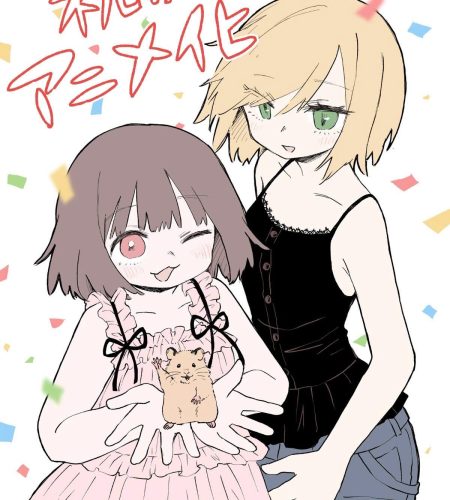
Mii is a grown woman, already well into adulthood, but due to the congenital abnormalities resulting from her parents' incestuous relationship, her ability to retain memories and engage in long-term reasoning is so severely limited that she can't even handle jobs requiring the slightest degree of intellectual ability. As a result, the only way she can make money is by selling her body through prostitution. Yamada, on the other hand, is an ordinary young woman whose mother has already mapped out her entire future career for her. While working at various bars and izakayas in hopes of eventually becoming financially independent from her mother, she meets Mii and decides to take care of her as a friend.
The story essentially follows Yamada as she tries to teach Mii how to function in society like an ordinary person. And aside from the fact that Yamada's seemingly endless patience in caring for and trying to reason with someone who fundamentally struggles to understand or remember anything she's taught has already earned her a reputation among the fandom as a literal saint,which, yeah, we all know by now,I wanna rant a little about the actual nature of Yamada and Mii's relationship, and why Yamada chose to form this kind of relationship with Mii in the first place.
First of all, no matter how drastically their abilities to process and understand information may differ, Yamada and Mii actually share the same mindset when it comes to what we call "social structure." They both believe that this "social structure" is something fixed and unchangeable, something established by the will of a privileged minority to which neither of them belongs. So, from the very beginning, they've already accepted the idea that they have no power to reshape society according to their own wishes. All they can do is submit to the constraints it imposes on them and live according to someone else's will. And they both hate living like that, because at the end of the day, they're both human beings. They both have wills of their own,or, at the very least, they both want the society around them to acknowledge that they possess their own agency, their own individual worth, and a value to their existence that belongs to them alone, rather than having those things exist solely in their own imagination, only to be easily forgotten and disappear without a trace.
Now, with Mii, it's pretty obvious why she doesn't want to live shackled by the constraints of this so-called social structure. The problem is that her brain simply isn't capable of understanding that society isn't actually some predetermined system handed down by those in power, as she believes it to be. Instead, it's something formed through the collective agreement of the people living within it, following a long, messy, and often ambiguous process of negotiation over whose desires get to be fulfilled and whose desires must be compromised or sacrificed to make room for someone else's. Because Mii can't grasp that process, she's never really had the ability to become an active participant in shaping or maintaining the social structure around her. And it's not merely because she doesn't want to participate, but also because she lacks the cognitive ability to function the way an ordinary person is expected to, since she certainly isn't an ordinary person. So, the only way she's able to participate in society is as a human body stripped of any recognized agency, a body that other people can simply do whatever they please with.
Yamada's situation, however, is different. The reason Yamada herself fails to recognize that social structure isn't actually fixed, and that it's constantly being shaped by ordinary people just like her, can be traced all the way back to her relationship with her mother. Rather than explaining the principles governing society and allowing Yamada to decide for herself whether those principles made sense and were worth following, her mother simply exploited the power imbalance between parent and child to impose those principles upon her daughter, and kept doing so until Yamada reached a point where she could barely even recognize that she might have desires of her own beyond the obligation to dance to her mother's every command. That's why, whenever Mii asks Yamada why they have to follow certain rules, none of Yamada's so-called "explanations" ever actually addresses why those rules exist in the first place, or what either of them might gain from following them. Instead, her answers always boil down to some variation of "Because that's just what everyone does." Even when it comes to explaining why incest is forbidden, the only answer Yamada can come up with is that normal people find it disgusting. And that's it. Now, to be fair, it's understandable why adults might prefer forcing children to obey rather than actually explaining things to them, because explaining the reasoning behind social rules is complicated and time-consuming, and it's obviously a lot more of a hassle than just, well, making kids obey until they eventually start treating obedience as their natural state of existence. But the consequence of raising children that way is that you end up with people like Yamada.
As the story portrays it, Yamada has long since forgotten the original, autonomous will she once possessed as a young, innocent child, and ironically, it takes someone as "abnormal," as far outside society's standards as Mii, to awaken that forgotten part of herself again. And that's precisely why Yamada chooses to take Mii in and care for her,because Mii is, in a sense, a reflection of the self Yamada lost a long time ago. By caring for Mii, Yamada hopes to nurture that lost version of herself, allowing the two of them to grow together inside a room secluded from the rest of the "social structure" that Yamada believes has no place for either of them. But here's the problem. As I mentioned earlier, Yamada was never taught, and therefore never came to understand, that people living harmoniously together,whether in a tiny apartment or an entire society,doesn't necessarily mean one group has to be the one making all the rules while everyone else is forced to obey. In Yamada's eyes, rules, and the social structure built upon them, exist solely to serve the will of a privileged group of people. That group stands above everyone else, completely separate from the supposedly inferior people beneath them, who are simply too powerless to do anything except accept those rules as though they were laws of nature. And Yamada sees herself as one of those powerless, inferior people, someone who exists on the margins of society. But inside her own room, when it's just her and Mii, someone with an intellectual disability who is even more dependent and powerless than she is, the power dynamic suddenly flips. Now Mii is the inferior one, the helpless one, and naturally, that means Yamada's desires should be the ones dictating everything within their little world, not Mii's.
But unlike Mao, the ex-boyfriend whose psychological tendencies are remarkably similar to everything I've just described about Yamada, Yamada genuinely wants to understand Mii. Because, fundamentally, what Yamada wants is to nurture the image of a "free, unspoiled Yamada" that she sees reflected in Mii and help that image grow into adulthood. And that necessarily means she has to raise a Mii-chan who is free and happy, just like the beautiful version of herself that Yamada believes she has lost. But Mii is Mii, and the "free, unspoiled Yamada" is the "free, unspoiled Yamada." They're not the same person. Their individual desires can never perfectly align, just as Yamada's imagined version of her own liberated self can never be perfectly embodied by a liberated Mii. So, regardless of how different Yamada's treatment may be, or how much kinder and more beautiful it may appear on the surface, the thing she's imposing on Mii is ultimately the very same kind of shackles that Mao once placed on her, the same kind of restraint imposed by someone in a position of power upon someone they consider inferior and helpless. Meanwhile, because Yamada values Mii so deeply, almost as though her own lost sense of self has finally found someone who needs it, Mii begins to grow arrogant. She starts openly expressing her own desires and expecting Yamada to indulge them, confident in the belief that Yamada needs her to be free like this. After all, isn't that exactly what Yamada wants from her? Except the truth is that what Yamada needs isn't Mii herself. It's the idealized image of herself that she sees in Mii.
Kinda sounds like Yamada's raising a doll or keeping a pet, huh? lol. And honestly, if you look at things through Yamada's own understanding of relationships, calling it something akin to keeping a pet wouldn't exactly be wrong. Because the relationship she's created with Mii is fundamentally one between a superior figure, someone who has the authority to impose her own will upon the little world contained within their shared room, and a subordinate figure, someone supposedly incapable of possessing an independent will and who can only grow under the protection of the person above her. And even that "growth" is something that must happen according to the superior figure's own wishes and the path she has already laid out. So yeah, when you put it that way, it really does sound like keeping a pet. Except Mii is a human being with a will of her own. No matter how stupid or helpless she may be, she still has her own desires, her own wishes, and her own sense of self. And it's precisely Yamada's deeply mistaken belief that a relationship must naturally involve someone who has no will of their own, someone who is entirely dependent on a superior figure, that makes the whole thing so troubling. Because that's exactly the kind of relationship Yamada herself was taught to accept as "natural" throughout her life in society. And as long as she continues to believe that this is simply how relationships are supposed to work, there's no way this is going to end well for either of them.
https://www.facebook.com/share/p/1CKs9ieBgs/?mibextid=wwXIfr
Subscribe to our email newsletter to get the latest posts delivered right to your email.