
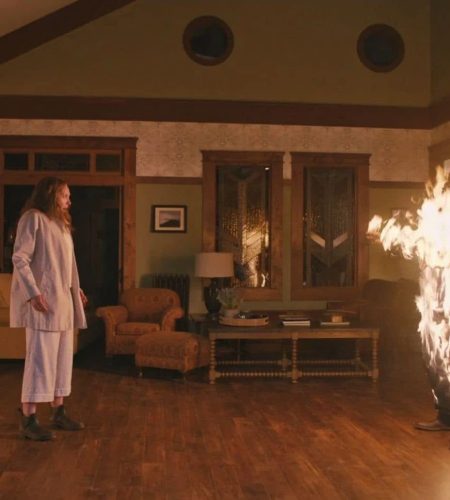
It is relatively conventional for a Greek tragedy to deprive its characters of the ability to determine the outcome they will ultimately arrive at, as well as to emphasize this by presenting prophetic signs of an undesired outcome that the characters, precisely because they know of it/ despite knowing of it, still cannot escape leading themselves toward—Oedipus, Electra, and Heracles. In Hereditary, there is a scene in which the eldest son, Peter, listens to his teacher lecture on the subject of “escaping one’s fate,” with Heracles as the subject of analysis. The teacher’s conclusion is that Heracles failed because he had been so confident in believing that he was the one in control of the situation, and that he had never had the right to choose in the first place.
This is a piece of foreshadowing as well as an implicit confirmation of considerable value to a complex story compressed into the two hours and seven minutes of Hereditary: When the Graham family members’ struggles to choose a favorable outcome ultimately turn out to be nothing more than graceful dances through the clouds, serving only to bring the Greek tragedy in which they have been involuntarily cast into reality. In this tragedy, Annie Graham is the character most directly subjected to manipulation, and at the same time, the character who struggles against it most fiercely.
Annie’s mother, Ellen Leigh, having been born during the era of the Great Depression, became a key member of a cult devoted to the worship of Paimon—one of the eight emperors of Hell—in search of salvation through the wealth and glory or infinite knowledge that he was capable of bestowing upon his followers once brought back into the material world. In order to exist as part of the material world, Paimon needs to possess the body of a male host and be presented with three heads belonging to three generations of the same bloodline as the one seeking to summon him (as depicted in the illustration of Paimon sitting atop a camel with three human heads attached to its side). And thus, the new lives born from Ellen Leigh’s bloodline were turned by her into sacrificial lambs for the resurrection of the demon.
The cult thus established the theoretical framework for a theatrical performance welcoming the demon, in which they bound the lives of Ellen Leigh’s descendants to the fate/roles she had assigned them in a play that had existed even before they were born into this world—the body of the son whose role was to serve as Paimon’s host, and the bodies of the three daughters whose roles were to serve as accompanying offerings. The elaborate play welcoming the deity back into the mortal world had, in theory, already been laid out in its entirety, and now merely needed to be actualized by its human actors. Since the participation of these “actors” did not arise from an exchange of benefits between the two parties, the cult could not expect Ellen Leigh’s children to be raised naturally or be allowed to experience the vast world through all the senses available to them, only to then demand that they throw away their entire lives to become sacrificial offerings that would bring their mother salvation from a dark historical period that had long since passed, or satisfy the desire of the cult members to thoroughly comprehend this universe; thus, Ellen Leigh exercised meticulous control over the lives of her descendants in order to transform the act of playing a role in the tragedy from an autonomous choice into the fundamental definition shaping their personalities—they had to do it because that role was precisely who they were.
If we regard hereditary characteristics and experiences of the environment/interactions with the environment, received through the filter formed by your own way of thinking, as the elements that shape who you are—distinguishing you from the collective of humanity as a separate individual—then Ellen Leigh had always sought to seize control of both of these defining elements in the children she brought into the world. We can imagine the formation of a child’s identity as something like flour being bound together into a one-of-a-kind structure, with the baker then giving that one-of-a-kind structure a name. And when it came Ellen Leigh’s turn to use flour to mold identities for her descendants, she pressed the dough into a preexisting mold so that the identity of the child—which determines its way of thinking and the choices arising from that way of thinking—and the role in the play that she wanted the child to perform would become one and the same => Playing that role would thereby become as natural to the child as simply being itself. When people say that the Graham family has no “free will,” what they mean is that they cannot do anything other than what they themselves would do—that they have no choice other than to choose to be themselves.
Actually, most debates surrounding free will that are grounded in determinism are pretty much like this too. The person who is “you,” or the choices that person makes, is determined by things beyond your own reach, such as the environment or the characteristics you inherit from your parents, and since “free will” is defined as the ability to make decisions independently of external factors, people conclude that humans do not have free will. But both the act of questioning whether the person who is “you” has free will—whether that person makes decisions based on their own self—even before that self has come into existence in the world (when the environment and the characteristics inherited from one’s parents are still separate and have yet to form a “self”), only to claim that the formation of that self was beyond your personal will (as though accusing someone of violating a law that has not even been made public yet); and the act of, after having already delineated/defined your “self” as any unique convergence of elements arising from some combination of environment and inherited characteristics, turning around and claiming that following what this collection of elements wants—following what “you” want—is not freedom, don’t sound very convincing when compared with the definition of free will, do they? So are the elements that constitute you ultimately not you after all? Then Annie’s choice to have children because she herself felt guilty toward her mother, her decision to allow her eldest son Peter to drive his younger sister to a party to free the little girl from the darkness of her grandmother, or her choice to throw the book into the fireplace because she herself believed that doing so was the way to bring this tragedy to an end—weren’t all the choices Annie made throughout her life made by her? If so, then are the chemical reactions occurring in Annie’s brain, her thoughts, and her own personal lens of perception that led her to make those choices not actually Annie herself? Then who exactly is “Annie Graham” supposed to be?
Having realized that what she was imprisoned by was nothing other than this very shell called “Annie Graham,” she reconstructed all the moments of her life from an “objective perspective”—as Annie herself described this work to her husband—to express her longing to escape the curse of being “herself.”
But then, as everyone knows, Annie ended up smashing to pieces all the models she had built with her own hands in an attempt to imitate an objective perspective on creation. Because, in the end, human beings still cannot step outside the confining cage that is themselves, in their fully embodied form of flesh and bone, to reach the objective.
Subscribe to our email newsletter to get the latest posts delivered right to your email.